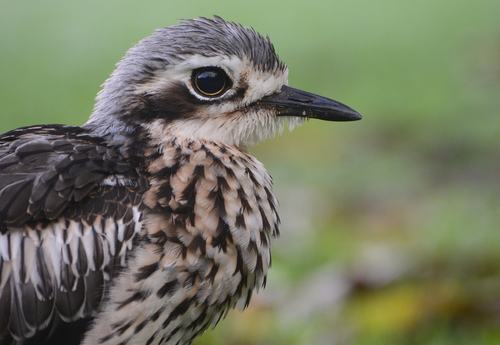
Bush Stone-curlew
Burhinus grallarius
Master of the midnight wail and the 'statue' pose, the Bush Stone-curlew is Australia's most charismatic nocturnal ground bird. With its striking yellow eyes and incredible camouflage, it turns any suburban backyard into a wild woodland stage.
Quick Identification
Size
Length: 55-60 cm (22-24 in); Wingspan: 80-105 cm (31-41 in); Weight: 700-1000 g (1.5-2.2 lbs)
Colors
Mottled grey-brown upperparts with heavy black and rufous streaks; pale underparts with fine streaking; prominent white 'eyebrow' stripe and large yellow iris. Sexes are monomorphic (look identical).
Key Features
- Large yellow eyes for nocturnal hunting
- Long, knobby grey-green legs
- Cryptic streaked plumage for ground camouflage
- Freezes in a rigid, tilted 'statue' posture when threatened
- Loud, mournful 'weer-lo' whistling call
When You’ll See Them
Geographic range
Where Does the Bush Stone-curlew Live?
The Bush Stone-curlew is native to the Australian continent and parts of southern New Guinea. While they were once common across the entire mainland, they are now most densely populated in northern and eastern Australia, particularly throughout Queensland and the Northern Territory. In southern Australia, their range has become more fragmented due to habitat loss and predation, though they remain a common and beloved sight in many coastal suburban neighborhoods and rural townships.
Basemap © OpenStreetMap contributors
Behavior
The Bush Stone-curlew is a master of camouflage and a primarily nocturnal specialist. During the day, it spends most of its time sitting quietly in leaf litter or under the shade of a tree. When it senses a threat, rather than flying away, it relies on its cryptic plumage and adopts a peculiar rigid posture—either standing perfectly still with its neck stretched out or crouching flat against the ground. This behavior makes them nearly invisible to the untrained eye among dry grass and twigs.
Socially, these birds are typically found in pairs or small family groups and are highly territorial. They are most famous for their vocalizations; a haunting, high-pitched wail that can sound like a human scream to the uninitiated. This call is most frequent on moonlit nights and is used to maintain pair bonds and warn off intruders. Despite being capable flyers, they are almost exclusively ground-dwelling, walking with a slow, deliberate gait as they stalk their prey.
EverydayEarth exclusive
Camera Tips
To capture the best footage of a Bush Stone-curlew, your camera must be positioned low. These are tall birds, but they spend 100% of their time on the ground. Mount your camera between 30 and 45 centimeters (12-18 inches) off the ground, angled slightly upward or kept level. Placing the camera too high will result in top-down shots that miss their distinctive large yellow eyes and gangly legs. Look for open patches of ground adjacent to shrubs or fallen timber where they like to 'roost' during the day.
Because they are nocturnal, a camera with high-quality infrared (no-glow) LEDs is essential. Standard white-light flashes can startle them and cause them to flee, whereas no-glow infrared allows you to capture their natural foraging behavior. They are creatures of habit and often walk the same 'patrol' lines through a backyard or park every night. If you hear them calling, try to identify their walking path—often along fence lines or garden edges—and set your camera there.
You don't need traditional bait to attract them, but a bird-friendly garden is a huge draw. Maintaining a layer of organic mulch or leaf litter encourages the insects and snails they feed on. Providing a shallow, wide water bowl at ground level is also an excellent way to bring them directly into your camera's frame, especially during dry spells. During the breeding season (August to January), keep your distance if you find a nest, as the parents will freeze in place; a camera with a good motion trigger from 3-5 meters away will give you a front-row seat to their parenting without causing them stress.
Similar Species
Species that look similar or are commonly confused with Bush Stone-curlew.
Beach Stone-curlew
Much larger with a massive, thick bill; strictly coastal habitat compared to the bush-dwelling nature of the Bush Stone-curlew.
Australian Bustard
Significantly larger and taller with a white neck and dark cap; lacks the intricate streaked camouflage and large yellow eyes of the curlew.
Frequently Asked Questions
Record Bush Stone-curlew at your habitat
Connect a camera to start building your own species record — AI identifies every visitor automatically.