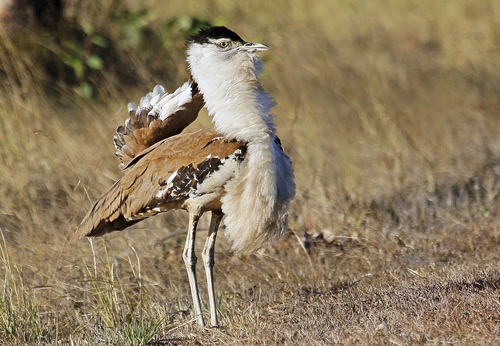
Australian Bustard
Ardeotis australis
The Australian Bustard is the regal giant of the outback, standing a metre tall with a stately, dignified walk. A nomadic wanderer of the grasslands, it is one of Australia's most impressive and elusive ground-dwelling birds.
Quick Identification
Size
Height: 80–130 cm (31–51 in); Wingspan: 1.7–2.3 m (5.6–7.5 ft); Weight: Males 5–14.5 kg (11–32 lb), Females 2–5 kg (4.4–11 lb)
Colors
Mottled brown, black, and white wings; white or pale grey underparts; grey neck with a black breast-band; black crown on head.
Key Features
- Tall, upright 'stately' posture when walking
- Large black crown and white stripe above the eye
- Thick, pale legs with only three forward-facing toes
When You’ll See Them
Geographic range
Where Does the Australian Bustard Live?
Native primarily to the Australian continent and parts of southern New Guinea, the Australian Bustard thrives across the tropical north and the arid central regions. While they were once common in southern Australia, their range has contracted significantly due to habitat alteration, and they are now most frequently encountered in Queensland, the Northern Territory, and Western Australia. As a nomadic species, they do not have fixed territories and will travel hundreds of kilometres to find suitable feeding grounds after rain.
Basemap © OpenStreetMap contributors
Behavior
The Australian Bustard is a dignified and cautious ground-dweller, often seen walking with a slow, measured gait and its head tilted slightly back. Known colloquially as the 'Bush Turkey,' it is a master of camouflage despite its large size. When it senses danger, the bustard often freezes, relying on its mottled plumage to blend into the dry grass, or it may walk away slowly rather than taking flight. They are strong flyers but prefer to remain terrestrial unless they need to travel long distances.
These birds are highly nomadic, following the 'green flush' of new growth and insect outbreaks that follow erratic rainfall in the Australian interior. During the breeding season, males are solitary and perform elaborate 'lekking' displays to attract females. They inflate a large sac in their throat until it reaches the ground, fan their tails, and emit low-frequency booming sounds that can be heard from a significant distance.
EverydayEarth exclusive
Camera Tips
Because Australian Bustards are tall birds that spend their lives on the ground, camera placement is critical. Set your camera on a fence post or a low tree trunk about 50 to 70 centimeters (20-28 inches) off the ground. Angle the camera horizontally or slightly upward to capture the full height of the bird. If the camera is too low and tilted down, you might only get shots of their thick, scaly legs. Ensure you have a wide field of view, as these birds have a wide stride and can move through a frame quickly despite their slow appearance.
These birds are attracted to water sources in arid environments and areas with high insect activity. Placing a camera near a stock trough or a known 'soak' is an excellent strategy. During the breeding season (typically after rain), look for open 'display' areas where males might gather. These are often slightly elevated spots with short grass. While you shouldn't use food bait, cameras placed near fruiting native shrubs like Santalum or Carissa species can be very effective.
Set your camera to a high-sensitivity motion trigger and use a rapid-fire burst mode. Bustards are often cautious and may stop to investigate a clicking sound, giving you a perfect profile shot. Since they are most active during the cooler parts of the day, ensure your camera's exposure settings handle the long shadows and golden light of early morning and late afternoon well. If your camera supports it, 4K video is highly recommended to capture the subtle, booming throat-sac display of the males.
Similar Species
Species that look similar or are commonly confused with Australian Bustard.
Frequently Asked Questions
Record Australian Bustard at your habitat
Connect a camera to start building your own species record — AI identifies every visitor automatically.