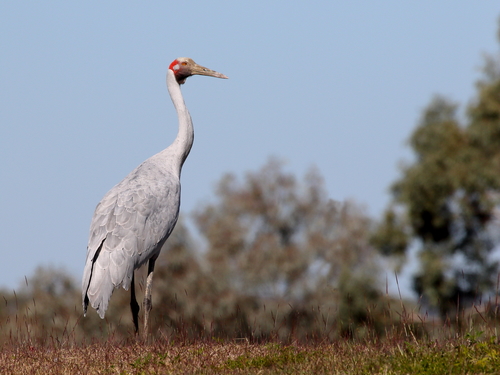
Brolga
Antigone rubicunda
Australia's elegant 'Native Companion,' the Brolga is famous for its intricate dancing and haunting trumpeting calls. These statuesque cranes are a symbol of the Australian wetlands, embodying grace and social connection.
Quick Identification
Size
Height of 0.7 to 1.3 metres (2.3 to 4.3 feet) with a wingspan of 1.7 to 2.4 metres (5.6 to 7.9 feet); weighs 5 to 8.7 kg (11 to 19 lbs)
Colors
Uniform silvery-grey plumage with darker grey-black flight feathers. Distinctive bare red-to-orange skin on the head and a black pendulous dewlap under the throat.
Key Features
- Tall, slender silvery-grey body
- Bare red skin patch covering the face and back of the head
- Black pendulous dewlap hanging from the chin
- Long, dark grey legs and a straight, spear-like bill
When You’ll See Them
Geographic range
Where Does the Brolga Live?
The Brolga is a quintessential bird of the Oceania region, found primarily across Northern and Eastern Australia. Its core range stretches from the Kimberley region in Western Australia, through the Top End of the Northern Territory, and down the entire eastern coast through Queensland into Victoria and eastern South Australia. Beyond the Australian mainland, isolated populations thrive in the wetlands of Southern New Guinea and occasionally on islands in the Torres Strait.
Basemap © OpenStreetMap contributors
Behavior
Brolgas are world-renowned for their elaborate and rhythmic dancing displays. These performances are not just for courtship; they are social bonding rituals involving bowing, leaping high into the air, tossing grass, and flapping their enormous wings. When a pair dances together, they often synchronize their movements while letting out a loud, rattling trumpeting call that can be heard for kilometres across the plains.
These birds are highly social outside of the breeding season, often gathering in large flocks of several hundred near permanent water sources during the dry season. They are generally wary of humans and will maintain a significant distance, but they can become accustomed to observers in areas where they are not disturbed. Their social structure is built around long-term pair bonds and family units that stay together for many months.
EverydayEarth exclusive
Camera Tips
Capturing a Brolga on camera requires a different approach than smaller backyard birds due to their immense height and shy nature. If you live near a wetland or large open paddock where they forage, position your camera at a height of about 1 to 1.5 metres. Rather than pointing the camera down, ensure the lens is level with the horizon to capture their full profile and those incredible leaps during their dancing displays.
Because Brolgas are easily spooked by human movement, a trail camera with a high-quality PIR (passive infrared) sensor is essential. Place the camera near the edge of water bodies or 'soaks' where you have seen them digging for tubers. Brolgas have excellent eyesight, so camouflaging the camera housing with local grasses or bark can prevent them from investigating and potentially knocking over your equipment.
Wider lenses are your best friend with this species. A Brolga stands as tall as a person, so if the camera is too close, you will only capture their legs. Set your camera back at least 5 to 8 metres from the expected activity zone to ensure you frame the entire bird, including its wingspan when it takes flight or begins to dance. High shutter speeds are a must if your camera allows, as their movements during social displays are lightning-fast.
Time your recording for the 'golden hours' of early morning and late afternoon. This is when Brolgas are most active and when the low sun highlights the beautiful silver sheen of their feathers and the vibrant red of their head patches. Avoid using artificial lures or bait; instead, focus on natural corridors between wetlands and foraging grounds to capture their most authentic behaviors.
Similar Species
Species that look similar or are commonly confused with Brolga.
Sarus Crane
The Sarus Crane has red skin extending down the neck and noticeably pink or reddish legs, whereas the Brolga has grey legs and a black dewlap.
Heron
Herons are smaller, lack the red head patch, and fly with their necks tucked in an 'S' shape, while Brolgas fly with their necks fully extended.
Frequently Asked Questions
Record Brolga at your habitat
Connect a camera to start building your own species record — AI identifies every visitor automatically.