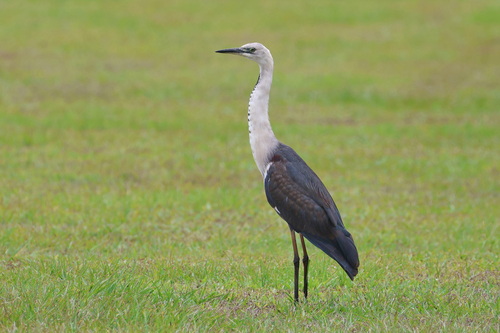
White-necked Heron
Ardea pacifica
A majestic and stoic hunter, the White-necked Heron is the nomad of the Australian wetlands. Known for its incredible patience and striking monochrome plumage, it is a rewarding sight for any backyard observer.
Quick Identification
Size
76–106 cm (30–42 in) in length; wingspan of 147–160 cm (58–63 in); weight roughly 800–1,200 g (1.8–2.6 lbs)
Colors
Distinctive white head and neck; dark slate-grey to blackish body; white patches under the wings visible in flight; black bill and legs; yellow eyes
Key Features
- Stark white neck contrasting with a dark grey body
- Large, heavy-set heron build
- Double row of black spots down the center of the neck (breeding plumage)
- Slow, deep wingbeats in flight
When You’ll See Them
Behavior
The White-necked Heron is a solitary and patient hunter, often seen standing motionless for long periods beside water. It is a master of the 'wait-and-see' approach, keeping its long neck kinked in an S-shape before striking with lightning speed at unsuspecting prey. Unlike some other heron species that may forage in groups, this bird is generally territorial over its immediate hunting patch, though many may gather at a single location if a massive food source, such as a drying lake or a locust plague, occurs.
This species is famously nomadic, possessing an incredible ability to locate water across the arid Australian interior. They are often among the first waterbirds to arrive at a newly flooded area, sometimes appearing in regions where they haven't been seen for years. While they are usually wary of humans, they have become increasingly comfortable around large farm dams and rural properties where they can hunt undisturbed.
EverydayEarth exclusive
Camera Tips
To capture the White-necked Heron on camera, focus on the shallow margins of water bodies. Position your camera approximately 2 feet off the ground, aiming at a clear 'landing zone' or a flat rock near the water's edge where a bird might stand to fish. Because these are tall birds, ensure your camera angle is wide enough to capture their entire 3-foot frame; otherwise, you may end up with a lot of footage of just their legs or chest. Leveling the camera with the water surface provides a stunning, professional-looking perspective that highlights their reflection.
Since you cannot easily bait herons with traditional birdseed, you should focus on 'biological baiting.' Maintaining a healthy pond with plenty of native frogs and small fish is the best way to ensure regular visits. If your camera has a 'time-lapse' mode, consider using it during the early morning hours. These herons move so slowly while hunting that they may not always trigger a standard motion sensor until they strike, at which point the action might be over. A high-sensitivity PIR setting is essential to catch their subtle movements.
Lightning and environmental settings are crucial for this species. Their white necks are highly reflective and can easily 'blow out' or lose detail in bright midday sun. Set your camera to underexpose slightly if possible, or place the camera so the sun is behind it during the peak morning or afternoon hours. For video, use the highest frame rate available (60fps or higher). The strike of a White-necked Heron is one of the fastest movements in the animal kingdom, and slow-motion playback of a successful hunt is truly spectacular content for any backyard wildlife enthusiast.
Similar Species
Species that look similar or are commonly confused with White-necked Heron.
Frequently Asked Questions
Record White-necked Heron at your habitat
Connect a camera to start building your own species record — AI identifies every visitor automatically.