Buttonwood
Glochidion harveyanum
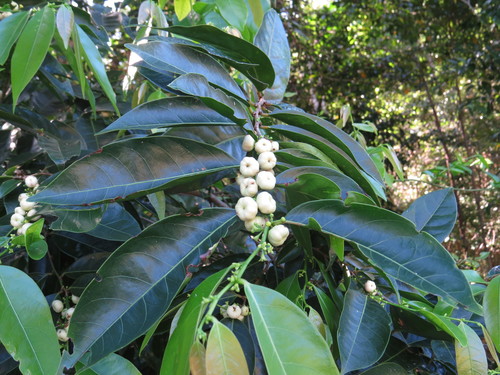
The Buttonwood is a tropical marvel famous for its miniature pumpkin-shaped fruits and its secret nighttime partnership with specialized moths. A staple of Northern Australian landscapes, it brings a touch of the rainforest to any backyard.
Quick Identification
Size
A shrub or small tree typically reaching 3–8 metres (10–26 feet) in height, with a canopy spread of 2–4 metres.
Colors
Glossy green leaves with paler undersides; fruits transition from light green to creamy-white or a distinctive pinkish-red when ripe.
Key Features
- Multi-lobed fruit shaped like a miniature pumpkin or flattened button
- Leaves arranged in two distinct rows along the branchlets
- Small, inconspicuous cream to yellowish flowers
- Slender, often drooping branches that create a dense canopy
When You’ll See Them
Geographic range
Where Does the Buttonwood Live?
The Buttonwood is native to the tropical reaches of Oceania, with its primary stronghold located in North Eastern Australia. It is most commonly found throughout the coastal and sub-coastal regions of Queensland, thriving in the transition zones between the beach and the rainforest. Beyond the Australian mainland, its range extends across the Torres Strait into the lush, diverse landscapes of Papua New Guinea, where it inhabits similar lowland and mid-elevation environments.
Basemap © OpenStreetMap contributors
Behavior
The Buttonwood is a fascinating specimen that demonstrates one of nature's most intricate partnerships. It is part of an obligate mutualism with Epicephala moths. Unlike most plants that wait for any passing insect, the Buttonwood relies specifically on these moths, which pollinate the flowers while simultaneously laying their eggs. This means the tree is a focal point for very specific insect activity that you won't see on other backyard plants.
In the wild and in gardens, it acts as a structural 'hub.' While it remains stationary, its dense foliage provides essential nesting sites and protection for small tropical birds and lizards. It is a hardy grower, often found in the understory of drier rainforests, where it waits for gaps in the canopy to push toward the light. For humans, it is a non-invasive, decorative addition that offers year-round visual interest through its changing fruit colors.
EverydayEarth exclusive
Camera Tips
To capture the best images of a Buttonwood, you should focus your camera on the development of its unique fruit. Mount your camera on a sturdy tripod or a nearby limb about 1.5 to 2 metres (5–6 feet) above the ground. Aim the lens at a cluster of flowers or young green fruits. Because the fruits are relatively small—about the size of a large marble—ensure your camera's focal point is locked so the foliage in the foreground doesn't trigger the sensor or blur the shot. High-resolution time-lapse settings are perfect for documenting the transition from the cream-colored flowers to the striking pinkish-red 'buttons.'
If you want to catch the secret life of the Buttonwood, you must set your camera for nighttime recording. The Leafflower Moths that pollinate this tree are strictly nocturnal. Use a camera equipped with high-quality infrared (IR) night vision to observe these moths as they dance between the flowers. Avoid using bright white-light flashes, as this will likely scare away the pollinators and disrupt the very behavior you are trying to film. Placing the camera within 30–50 cm (12–20 inches) of a flower cluster will provide the best chance of seeing these tiny insects in action.
For those interested in the birds that frequent the Buttonwood, place your camera at a wider angle overlooking the entire canopy. Small honeyeaters and silvereyes are often drawn to the dense cover. Early morning, between 6:00 AM and 9:00 AM, provides the best natural lighting for the glossy leaves and the most bird activity. If the tree is in a dry area, placing a small water source near its base and aiming a trail camera there can capture the various reptiles and mammals that use the Buttonwood's shade as a sanctuary during the heat of the day.
Similar Species
Species that look similar or are commonly confused with Buttonwood.
Frequently Asked Questions
Record Buttonwood at your habitat
Connect a camera to start building your own species record — AI identifies every visitor automatically.