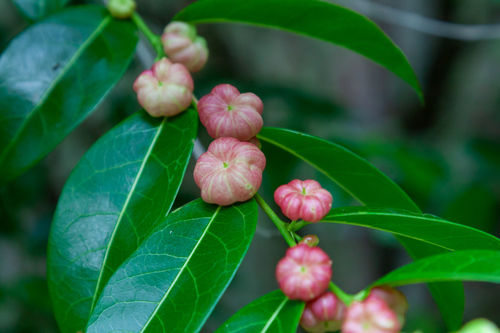
Cheese Tree
Glochidion ferdinandi
Famous for its whimsical fruit that looks exactly like miniature wheels of cheese, this Australian native is a bustling hub for colorful rainforest birds and local wildlife.
Quick Identification
Size
A small to medium tree reaching 8–20m (26–65ft) in height, with a canopy spreading 5–10m (16–33ft).
Colors
Glossy deep green leaves; pale greenish-yellow flowers; fruit capsules that transition from green to pinkish-red and finally woody brown.
Key Features
- Distinctive fruit capsules shaped like miniature 'cheese wheels' or pumpkins
- Glossy, elliptical leaves arranged in two rows along the branch
- Rough, grey-brown bark that becomes fissured with age
- Inconspicuous, tiny flowers that appear in the leaf axils
When You’ll See Them
Geographic range
Where Does the Cheese Tree Live?
Native to the continent of Australia, the Cheese Tree is a staple of the eastern coastline. Its core range extends from the Illawarra region in south-eastern New South Wales, stretching northward through the humid coastal forests and into the tropical regions of northern and inland Queensland. It is a familiar sight in both pristine rainforests and developing urban green spaces throughout these regions.
Basemap © OpenStreetMap contributors
Behavior
The Cheese Tree is a resilient and fast-growing pioneer species that plays a vital role in the ecosystem of eastern Australia. While it doesn't 'behave' in the animal sense, its lifecycle is defined by its prolific fruiting habits. The tree typically flowers during the warmer months, followed by the development of its namesake fruit. These 'cheese wheels' eventually split open to reveal bright red seeds that are highly attractive to local birdlife.
As a host plant, it supports various species of moths and butterflies, and its dense canopy provides excellent shelter for smaller woodland creatures. In a backyard setting, it is often favored for its ability to provide shade and its hardy nature, as it can tolerate a variety of soil types and even some light frost. It is a social hub for the neighborhood wildlife, acting as a natural canteen for frugivorous species.
EverydayEarth exclusive
Camera Tips
To capture the incredible variety of wildlife that visits the Cheese Tree, position your camera at a mid-to-high elevation. Aim for a branch heavy with ripening fruit capsules. Using a strap mount or a tree-screw mount about 2 to 3 meters (7-10 feet) up a nearby tree can provide the perfect vantage point. Angle the camera slightly downward toward the 'cheese' clusters to catch birds like Figbirds and Pigeons as they land to feed.
Because the Cheese Tree is a magnet for fast-moving birds, use a 'Fast' or 'High' trigger speed setting. If your camera supports it, the burst mode is ideal; capturing 3-5 photos per trigger will ensure you get a clear shot of a bird in mid-bite or with its wings spread. In the summer months, the bright green foliage can sometimes trick a camera's light meter, so try to position the lens so it isn't facing directly into the morning sun to avoid washed-out images.
For a unique perspective, consider setting up a time-lapse during the late summer. This can capture the fascinating process of the fruit capsules drying out and splitting open to reveal the bright red seeds. This slow transformation is often what triggers the arrival of larger bird species like the Topknot Pigeon. If you are targeting nocturnal visitors like Common Brushtail Possums, ensure your IR flash is set to 'Medium' to avoid overexposing the glossy leaves at night.
Similar Species
Species that look similar or are commonly confused with Cheese Tree.
Frequently Asked Questions
Record Cheese Tree at your habitat
Connect a camera to start building your own species record — AI identifies every visitor automatically.