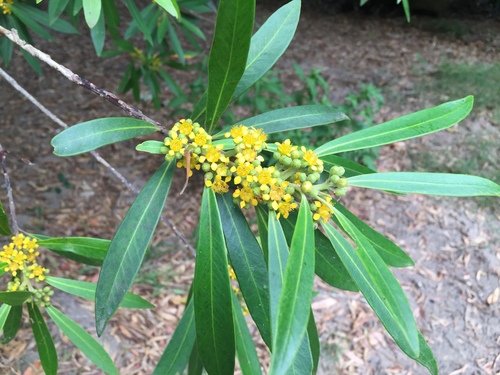
Water Gum
Tristaniopsis laurina
A masterpiece of the Australian riverside, the Water Gum features stunning peeling bark and vibrant summer flowers that serve as a lifeline for local pollinators.
Quick Identification
Size
Height: 5-15m (16-50ft) in gardens, up to 30m (100ft) in the wild; Width: 4-8m (13-26ft)
Colors
Glossy dark green leaves with pale undersides; creamy-grey to brown mottled bark; bright yellow flowers
Key Features
- Lance-shaped glossy leaves 5-12cm long
- Smooth, mottled bark that peels to reveal reddish-brown tones
- Small, 5-petaled yellow flowers in dense clusters
- Trunks often sculpted or leaning in the direction of water flow
When You’ll See Them
Geographic range
Where Does the Water Gum Live?
The Water Gum is a proud native of Eastern Australia, spanning a wide latitudinal range from the temperate forests of Victoria through New South Wales and into the tropical regions of Queensland. It is almost exclusively found along the coastline and the Great Dividing Range, specifically hugging the banks of freshwater streams. Due to its popularity as an ornamental street tree, it is now a common sight in suburban neighborhoods throughout Australia's eastern states.
Basemap © OpenStreetMap contributors
Behavior
The Water Gum, also known as the Kanooka, is a slow-growing evergreen tree that acts as a vital anchor for riparian ecosystems. In its natural habitat along stream banks, it exhibits a fascinating growth habit where its trunk and branches are often permanently shaped by the pressure of floodwaters, leaning in the direction of the current. This makes the tree a living record of the waterway's history and flood levels.
In a backyard or park setting, the Water Gum is far more upright and symmetrical, forming a dense, rounded canopy that provides excellent shade. While it is a stationary organism, it is a hub of activity; during the summer months, it becomes a 'super-food' source for local pollinators. It is highly regarded by gardeners for its non-invasive root system and its ability to withstand both heavy rainfall and moderate drought once established.
EverydayEarth exclusive
Camera Tips
To capture the best action around a Water Gum, focus your camera on the flowering clusters during the peak of summer (December and January). Position your AI camera at a height of 5 to 6 feet, angled slightly downward toward a branch that receives plenty of morning sunlight. This is the optimal time to record various honeyeaters, native bees, and butterflies that are drawn to the nectar-rich yellow blossoms.
The unique, mottled bark of the Water Gum is another high-traffic area for wildlife. Place a camera focused on the main trunk at a height of about 3 feet to capture scans of tree-climbing reptiles like the Eastern Water Dragon or Lace Monitor, which often use the smooth bark as a path to the canopy. Ensure the camera is set to a fast shutter speed or high-frequency trigger, as lizards can move surprisingly quickly across the smooth surface.
If you are near a creek where Water Gums grow, look for specimens with trunks leaning over the water. These are perfect spots for a trail camera to capture water birds or even mammals using the leaning trunk as a bridge. For backyard cameras, avoid placing the sensor directly facing the dense, glossy foliage in a windy spot, as the high reflectivity of the leaves and the movement can cause frequent false triggers. Instead, aim for a clear view of the branch tips where the flowers are most concentrated.
Similar Species
Species that look similar or are commonly confused with Water Gum.
Frequently Asked Questions
Record Water Gum at your habitat
Connect a camera to start building your own species record — AI identifies every visitor automatically.