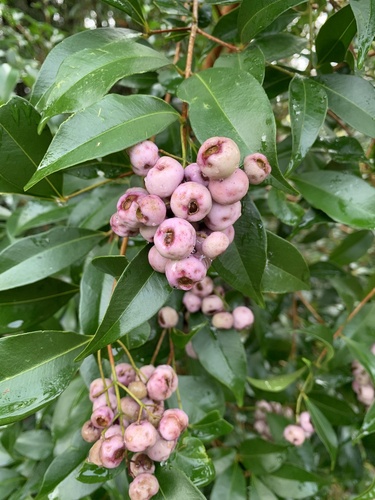
Lilly Pilly
Syzygium smithii
A vibrant cornerstone of the Australian garden, the Lilly Pilly dazzles with glossy evergreen leaves and colorful winter berries. This hardy tree is a magnet for colorful parrots and essential pollinators, making it the perfect focal point for any backyard wildlife camera.
Quick Identification
Size
3–5 m (10–16 ft) in gardens; up to 20 m (65 ft) in rainforest settings
Colors
Glossy deep green foliage with flushes of bronze-pink or red new growth; creamy-white flowers; white to maroon berries.
Key Features
- Glossy, lance-shaped waxy leaves
- Vibrant pink or bronze-tinted new growth at branch tips
- Clusters of spherical edible berries ranging from white to deep purple
- Rough, brown woody bark on mature specimens
When You’ll See Them
Geographic range
Where Does the Lilly Pilly Live?
The Lilly Pilly is a quintessential Australian native, primarily hugging the eastern coastline of the continent. Its natural range stretches from the tropical reaches of North Queensland, winding down through the moist forests of New South Wales, and reaching into the cooler gullies of Victoria. While it is a staple of Australian rainforests and coastal scrubs, it has also been introduced as a popular ornamental plant in New Zealand and southern California, where it thrives in Mediterranean climates.
Basemap © OpenStreetMap contributors
Behavior
The Lilly Pilly is a hardy and versatile evergreen known for its dense, bushy growth habit. In the wild, it functions as a mid-story rainforest tree, providing a thick canopy that offers shelter to numerous small animals. In suburban environments, it is most frequently encountered as a high-performance hedge or privacy screen, as it responds exceptionally well to pruning and shaping.
Ecologically, this species acts as a vital 'service station' for local wildlife. During the summer months, its fluffy, stamen-rich flowers attract a frenzy of nectar-seeking insects and bees. As winter approaches, the tree produces a heavy crop of succulent berries. This timing is crucial, providing a reliable food source for fruit-eating birds and flying foxes when other food supplies might be scarce in the Australian bush.
EverydayEarth exclusive
Camera Tips
To capture the wildlife activity around a Lilly Pilly, position your camera approximately 1.5 to 2 meters away from a cluster of ripening berries. During the winter months, this is the 'hot zone' for bird activity. Aim for a slightly elevated angle, as many fruit-eating birds like King Parrots and Silvereyes prefer feeding in the mid-to-upper canopy rather than on the ground.
If you are using an AI-powered camera like the ones featured on EverydayEarth, set your trigger sensitivity to high. Many of the visitors, such as honeyeaters and bees, are fast-moving. Using a fast shutter speed is essential to avoid motion blur when these birds flit between the dense foliage. If your camera supports it, the 'Photo Burst' mode is excellent for catching the exact moment a bird plucks a berry.
For a unique perspective, try a time-lapse setting during the spring. This can capture the dramatic transition of the 'flush'—when the tree suddenly erupts in bright pink new growth. Ensure the camera is mounted securely to a fence post or a heavy tripod, as the dense foliage of the Lilly Pilly can catch the wind and cause micro-vibrations that blur long-term time-lapse sequences.
Lastly, consider the lighting. Lilly Pilly leaves are highly reflective and waxy. Position your camera so the sun is behind it to avoid harsh glints off the foliage, which can trick the camera's light meter and result in underexposed wildlife subjects. Early morning light (6-9 AM) provides the softest, most natural glow for the pink new growth and the white flowers.
Similar Species
Species that look similar or are commonly confused with Lilly Pilly.
Frequently Asked Questions
Record Lilly Pilly at your habitat
Connect a camera to start building your own species record — AI identifies every visitor automatically.