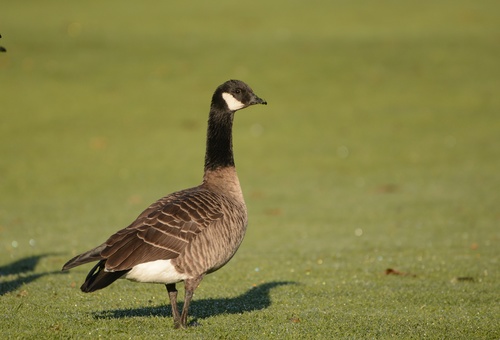
Cackling Goose
Branta hutchinsii
Often mistaken for a miniature Canada Goose, the Cackling Goose is a hardy Arctic traveler with a big personality. Discover how to identify this pint-sized navigator in your local parks and wetlands.
Quick Identification
Size
Length: 60–70 cm (24–28 in); Wingspan: 108–110 cm (42–43 in); Weight: 1.3–1.8 kg (2.9–4.0 lbs)
Colors
Black head and neck with a bold white 'chinstrap' patch; grayish-brown body with a pale breast and white undertail; black bill and legs.
Key Features
- Noticeably small, compact body with a short 'swan-like' neck
- Stout, short triangular bill
- High-pitched, squeaky cackling call
- Steep forehead profile compared to the flatter head of a Canada Goose
When You’ll See Them
Geographic range
Where Does the Cackling Goose Live?
The Cackling Goose is a native North American species that breeds across the remote Arctic tundra of Alaska and Northern Canada. During the winter months, these birds migrate south to the United States and Mexico, with high concentrations found in the Pacific Northwest and the Central Flyway. A distinct population also exists in East Asia, migrating between breeding grounds in Russia and wintering sites in Japan and eastern China.
Basemap © OpenStreetMap contributors
Behavior
Cackling Geese are highly social and energetic waterfowl, often moving in large, tight-knit flocks that can number in the thousands. While they closely resemble their larger Canada Goose relatives, they are significantly more agile in flight and have a distinctively higher-pitched voice that sounds like a frantic cackle. They spend much of their time on the ground grazing, but they are also strong swimmers and spend their nights floating in the safety of open water to avoid predators.
In suburban environments, they are frequent visitors to golf courses, city parks, and agricultural fields where they forage for waste grain. They are generally more wary and flighty than larger geese, often being the first to take flight when a perceived threat—like a dog or a human—approaches. During the breeding season in the Arctic, they become fiercely territorial, but throughout the winter migration, they are communal and often mix with other goose species.
EverydayEarth exclusive
Camera Tips
To capture high-quality footage of Cackling Geese, position your camera near the water's edge of a pond or in an open grassy area where they are known to graze. Since these birds are shorter than Canada Geese, a lower mounting height of 12 to 18 inches is ideal to get a head-on perspective rather than looking down on them. Use a wide-angle lens setting if your camera supports it, as these birds rarely travel alone and you'll want to capture the scale of the flock.
Baiting isn't usually necessary if you have a lush lawn or access to a shoreline, but scattering a bit of cracked corn or specialized waterfowl grain can encourage them to linger in front of the lens. However, be sure to check local ordinances regarding feeding wildlife. The best lighting occurs during the 'golden hours' shortly after sunrise and before sunset, which fortunately coincides with their peak foraging activity.
Because Cackling Geese move in groups and are quite active, set your camera's trigger interval to a short delay (3-5 seconds) or use 'burst mode' to capture the social interactions within the flock. High-speed shutter settings are recommended because their head movements and wing flaps are much more rapid than larger geese. If you are setting up near water, ensure your camera is well-camouflaged with marsh grass or burlap, as the 'scouts' of the flock are very observant and may steer the group away from an exposed camera.
Similar Species
Species that look similar or are commonly confused with Cackling Goose.
Frequently Asked Questions
Record Cackling Goose at your habitat
Connect a camera to start building your own species record — AI identifies every visitor automatically.