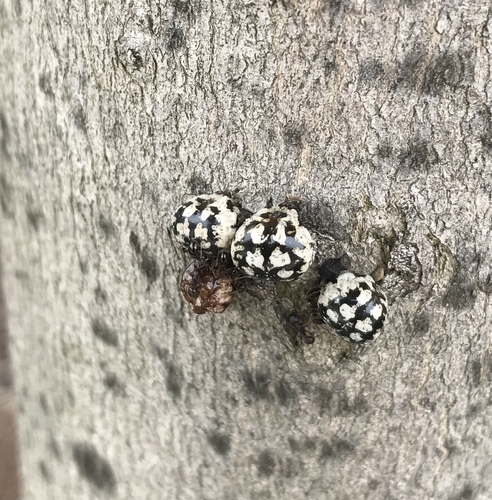
calico scale
Eulecanium cerasorum
A striking but stealthy garden resident, the Calico Scale is easily identified by the ornate white-and-brown pattern on its rounded shell. Often mistaken for a decorative bead, this insect is a fascinating example of specialized tree-dwelling life.
Quick Identification
Size
6-7 mm (0.25 inches) in diameter
Colors
Distinctive mottled pattern of creamy white and dark chocolate brown; matures to a uniform dark brown or black
Key Features
- Hemispherical, bead-like shape
- Mottled 'calico' pattern of white and brown
- Found primarily on tree twigs and branches
- Associated with sticky honeydew and black sooty mold
When You’ll See Them
Geographic range
Where Does the calico scale Live?
Originally native to East Asia, including Japan and China, the Calico Scale has successfully traveled across the globe to become a common sight in North America. It is now widely established throughout the United States, with particularly high concentrations in the Northeast, Midwest, and parts of California. This insect thrives wherever its preferred deciduous host trees are planted in temperate climates.
Basemap © OpenStreetMap contributors
Behavior
The Calico Scale is a fascinating, albeit destructive, member of the soft scale family. Unlike many insects that flit about your garden, the mature female Calico Scale is sessile, meaning she remains fixed in one spot on a tree branch for most of her life. She uses a straw-like mouthpart to pierce the bark and drink the nutrient-rich sap. This stationary lifestyle makes them look more like a natural growth or a small pebble than a living animal.
As these insects feed, they excrete a sugary substance known as honeydew. This sticky residue often coats the leaves and branches below the infestation, which in turn attracts 'honeydew harvesters' like ants and wasps. Over time, a black fungus called sooty mold typically grows on this honeydew, giving the tree a scorched or dirty appearance. While the scale itself doesn't move much, the ecosystem of insects it attracts creates a hub of activity on the branch.
EverydayEarth exclusive
Camera Tips
Capturing the Calico Scale on a backyard camera requires a specialized approach because these insects are small and do not move. For the best results, use a camera with a dedicated macro lens or a high-quality 'macro mode' setting. Position the camera just a few inches away from an infested branch, focusing specifically on the undersides of twigs where the scales congregate. A steady mount or a small tripod strapped to a neighboring branch is essential to prevent blur.
Since the scale itself is stationary, the most interesting footage often comes from the 'visitor' interactions. Set your camera to record short video clips or high-frequency time-lapse intervals to capture ants 'milking' the scale for honeydew. This symbiotic relationship is highly active during the daylight hours. If your camera has a ring light or built-in LED, use it to highlight the glossy, bead-like texture of the scale's shell against the rough bark.
Spring is the ideal time for photography, as this is when the females swell and display their most vibrant white-and-brown mottled patterns. By mid-summer, they lose their 'calico' look and turn a dull, dark brown before dying. Look for trees that show signs of 'weeping' sap or black mold on the lower leaves; this is a 'X marks the spot' indicator for where to point your lens.
Similar Species
Species that look similar or are commonly confused with calico scale.
Frequently Asked Questions
Record calico scale at your habitat
Connect a camera to start building your own species record — AI identifies every visitor automatically.