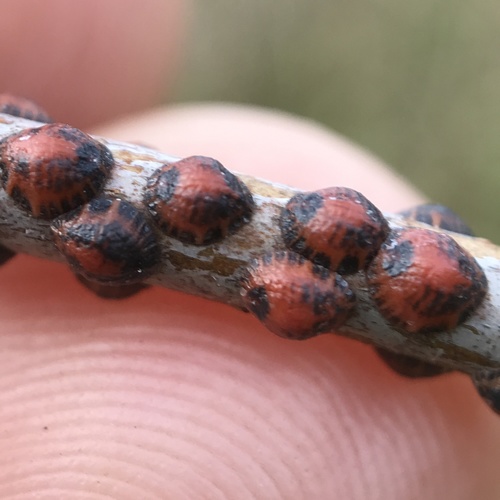
terrapin scale
Mesolecanium nigrofasciatum
Looking like miniature, ornate turtle shells stuck to a branch, the Terrapin scale is a master of camouflage and a cornerstone of the backyard insect economy.
Quick Identification
Size
3-4 mm (0.12-0.16 inches) in length; highly convex and nearly hemispherical
Colors
Reddish-brown to tan base with distinct black or dark brown radiating bands and blotches
Key Features
- Highly convex, turtle-shell-like shape
- Dark radiating bands or 'ribs' around the margins
- Usually found clustered on twigs and small branches
- Produces shiny, sticky honeydew
When You’ll See Them
Geographic range
Where Does the terrapin scale Live?
The Terrapin scale is native to the North American continent, specifically concentrating in the eastern and central regions. Its range extends from the southern provinces of Canada, such as Ontario and Quebec, down through the eastern United States to the Gulf Coast, and as far west as the edge of the Great Plains. Because it thrives on common ornamental trees like the Silver Maple, it is a frequent resident of human-altered landscapes throughout the American Midwest and New England.
Basemap © OpenStreetMap contributors
Behavior
Terrapin scales are fascinating examples of sessile insects. Once the female finds a suitable spot on a host tree branch, she attaches herself permanently, losing her legs and antennae through successive molts to become a stationary sap-sucking pump. They are often found in dense clusters, looking more like a natural growth on the bark than a living animal. Their most notable behavior is the excretion of honeydew, a sugary liquid that they expel in large quantities.
This honeydew creates a miniature ecosystem on the branch. Ants are frequently seen 'farming' these scales, protecting them from predatory ladybugs and lacewings in exchange for the sugary reward. In high populations, this honeydew can lead to the growth of black sooty mold, which covers the leaves and branches. While the females never move, the males are tiny, winged insects that emerge briefly in late summer to find mates before dying.
EverydayEarth exclusive
Camera Tips
Capturing the Terrapin scale on a backyard camera requires a specialized approach because adult females are immobile. A standard wide-angle trail camera will likely miss them unless it has an exceptional macro mode. For the best results, use a camera with a close-focus lens or a dedicated macro attachment. Focus your lens on the underside of one-to-two-year-old twigs on host trees like Silver Maple, Red Maple, or Peach trees. The scales often congregate in the lower canopy, making them accessible for mounting a camera on a tripod or a nearby branch.
Since the scales don't move, the real 'action' to record is the symbiotic relationship with other insects. Set your camera to time-lapse mode or high-sensitivity video to capture the constant traffic of ants. These ants act as sentinels, and their fast-paced movement around the stationary scales makes for compelling footage. Look for 'honeydew drops' forming on the rear of the scales; under the right lighting, these look like tiny glistening jewels before an ant consumes them or they fall to the ground.
Lighting is your biggest challenge. Because scales are often found on the underside of branches, they are frequently in deep shadow. Use a small, diffused external LED light if possible, or aim for 'golden hour' light when the sun is low enough to hit the undersides of the branches. In late spring or early summer (May to July), you can capture the 'crawler' stage—tiny, mobile yellow nymphs. These move surprisingly fast and can be seen swarming over the mother's shell before venturing out to find their own spot on the tree.
Similar Species
Species that look similar or are commonly confused with terrapin scale.
Frequently Asked Questions
Record terrapin scale at your habitat
Connect a camera to start building your own species record — AI identifies every visitor automatically.