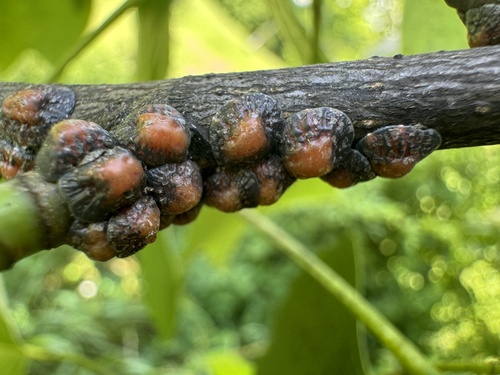
Tuliptree scale
Toumeyella liriodendri
The Tuliptree scale is a master of the sedentary life, masquerading as a simple bump on a branch while supporting an entire ecosystem of ants and fungi.
Quick Identification
Size
Adult females are 6-12 mm (0.25-0.5 inches) in diameter; crawlers are less than 1 mm (0.04 inches)
Colors
Females are pinkish-orange to mottled grayish-brown; crawlers are bright orange-red; often covered in black sooty mold
Key Features
- Large, convex, helmet-shaped female shells
- Sticky, clear honeydew secretions on nearby leaves
- Often found clustered on twigs and small branches
- Frequent presence of 'farming' ants and wasps
When You’ll See Them
Geographic range
Where Does the Tuliptree scale Live?
Native to the eastern half of North America, the Tuliptree scale thrives across the United States from the Gulf Coast to the Great Lakes and into southern Canada. It is most densely populated in the Appalachian region and the Southeast, following the natural distribution of the Tulip Poplar. While primarily an eastern species, it has been occasionally introduced to western states like California through the movement of nursery stock.
Basemap © OpenStreetMap contributors
Behavior
The Tuliptree scale is a fascinating, if sometimes destructive, example of a specialized sucking insect. Once the female crawler finds a suitable spot on a host tree's twig, she inserts her mouthparts and becomes sessile, remaining in that exact spot for the rest of her life. These insects are essentially living pumps, drawing sap (phloem) from the tree to fuel their growth and reproduction.
A defining characteristic of their behavior is the production of 'honeydew,' a sugary waste product. This sticky substance coats the leaves and branches below the colony, often leading to the growth of black sooty mold. This honeydew creates a complex social ecosystem; ants are frequently seen 'milking' the scale, protecting them from predatory ladybugs and lacewings in exchange for the sugary meal.
EverydayEarth exclusive
Camera Tips
Capturing the Tuliptree scale requires a macro-focusing strategy because of their small size and stationary nature. If you are using a backyard trail camera, look for models with a short focal distance or use a macro lens attachment. The best place to mount your camera is directly facing a branch or twig where the scale is already established; look for 'bumps' on the bark that look like tiny turtle shells.
Since the adult scales don't move, the real 'action' for your camera will be the symbiotic relationship with other insects. Position your camera to capture the traffic of ants moving up and down the branch. To get the best results, set your camera to a high-speed video or a rapid-fire photo mode during the bright hours of the afternoon when ant activity is at its peak. This will document the 'farming' behavior as ants collect honeydew.
For a truly unique perspective, set your camera to time-lapse mode during late August or early September. This is when the 'crawlers' (the mobile nymphs) emerge from under the mother's shell. While the adults are still, a time-lapse will reveal a surprisingly busy scene of hundreds of tiny orange specks scurrying across the bark in search of their own permanent feeding spots.
Lighting is your biggest challenge under a forest canopy or within thick foliage. Try to position your camera so the branch is side-lit by the morning or evening sun; this will highlight the waxy, convex texture of the scales and make them stand out from the bark. If your camera has a built-in flash, it can help define the shiny, sticky honeydew that often covers the area.
Similar Species
Species that look similar or are commonly confused with Tuliptree scale.
Frequently Asked Questions
Record Tuliptree scale at your habitat
Connect a camera to start building your own species record — AI identifies every visitor automatically.