Magnolia scale
Neolecanium cornuparvum
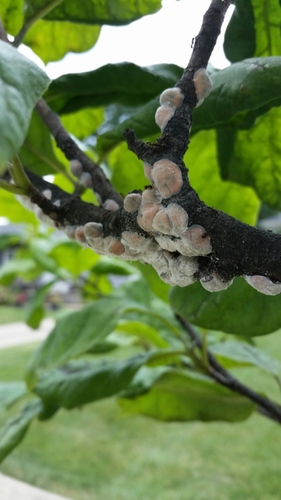
Often mistaken for plant buds, the Magnolia scale is a giant among scale insects. These sap-sucking specialists create a miniature ecosystem on magnolia branches, attracting ants and wasps to their sticky honeydew.
Quick Identification
Size
Adult females range from 10-13 mm (0.4-0.5 inches) in diameter, while males are much smaller and fly-like.
Colors
Females transition from a white, waxy 'bloom' to a smooth, pinkish-orange or tan; nymphs are dark brown or gray.
Key Features
- One of the largest scale insects in North America
- Convex, bumpy appearance resembling tree galls or buds
- Produces copious amounts of sticky honeydew and black sooty mold
When You’ll See Them
Geographic range
Where Does the Magnolia scale Live?
The Magnolia scale is native to the Eastern and Central regions of North America. Its range extends from the Gulf Coast of the United States northward through the Great Lakes region and into Southern Canada, specifically Ontario and Quebec. It is most commonly encountered in temperate zones where its primary host plants, such as the Star or Saucer Magnolia, are popular in residential landscaping.
Basemap © OpenStreetMap contributors
Behavior
These insects exhibit a fascinating symbiotic relationship with other backyard wildlife. Ants are frequently seen 'farming' the scales, protecting them from predators in exchange for the sugary honeydew. Meanwhile, the accumulation of this sticky residue often leads to the growth of black sooty mold, which can turn the entire trunk and leaves of a tree a charcoal color. In late summer, the scales produce 'crawlers,' the mobile nymph stage that travels to find new feeding grounds before overwintering.
EverydayEarth exclusive
Camera Tips
Capturing the Magnolia scale on camera requires a different approach than most wildlife, as the adults do not move. To get the best results, use a macro lens or a camera with a dedicated 'macro' mode. Focus your lens on the undersides of 1-to-2-year-old magnolia twigs. Because they are stationary, time-lapse photography is the most effective way to observe their development; setting a camera to take a photo every few days from June through August will show the dramatic shift from white waxy nymphs to large, tan adults.
To capture 'action,' aim your camera at a cluster of scales during the day to record the parade of visitors they attract. You will likely see ants tending to the scales, as well as various species of wasps, flies, and bees arriving to feed on the honeydew. These interactions are often very high-energy and make for excellent short video clips. Ensure your camera is mounted on a very stable branch or a tripod, as even a light breeze can cause the branch to move out of focus.
Late August and early September are the best times to see the mobile 'crawlers.' These tiny, dark nymphs are only about the size of a pinhead, so you will need to get as close as possible. Lighting is your best friend here—use a side-mounted light or a flash to create shadows that reveal the texture and convex shape of the scales against the bark. Avoid direct midday sun, which can wash out the white waxy coating on the insects.
Similar Species
Species that look similar or are commonly confused with Magnolia scale.
Frequently Asked Questions
Record Magnolia scale at your habitat
Connect a camera to start building your own species record — AI identifies every visitor automatically.