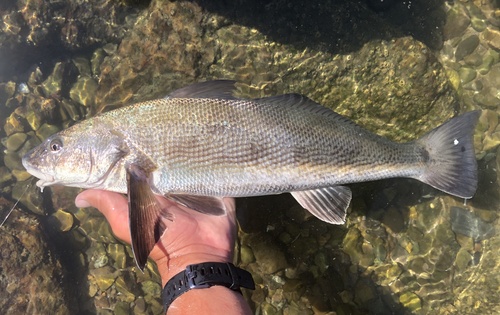
California Corbina
Menticirrhus undulatus
Known as the 'Ghost of the Surf,' the California Corbina is a sleek, silver specialist of the shallow waves. This elusive member of the croaker family is famous for feeding in water only inches deep along the golden beaches of the Pacific.
Quick Identification
Size
Typically 30-50 cm (12-20 inches) in length; maximum recorded length of 71 cm (28 inches) and weight of 3.8 kg (8.5 lbs).
Colors
Uniform metallic gray to silver-blue on the back, transitioning to a bright white belly. Some individuals show faint, wavy dark lines on their sides.
Key Features
- Single short fleshy barbel on the chin
- Slender, elongated body tapering toward the tail
- First dorsal fin is tall and triangular
- Lacks a swim bladder, allowing it to stay on the seafloor
When You’ll See Them
Geographic range
Where Does the California Corbina Live?
This marine species is native to the Eastern Pacific coastline of North America. Its core range is concentrated along the Southern California coast, extending from Point Conception southward to the tip of Baja California and throughout the Gulf of California in Mexico. They are most abundant in the warm coastal waters of the Southern California Bight during the summer months.
Basemap © OpenStreetMap contributors
Behavior
The California Corbina is a highly specialized bottom-dweller that has adapted perfectly to the turbulent environment of the Pacific surf zone. Unlike most fish, it lacks a swim bladder—the internal organ that controls buoyancy—which means it naturally sinks. This allows the Corbina to remain pinned to the sandy bottom even as heavy waves and strong currents crash around it, making it an incredibly effective predator in shallow water.
These fish are often seen in extremely shallow water, sometimes just inches deep, where their dorsal fins may even break the surface as they hunt. They travel in small, loose groups or as solitary individuals, following the tide as it moves across sandy beaches. While they are generally wary of shadows and sudden movements from above, they are persistent foragers that show little fear of the powerful whitewater in the swash zone.
EverydayEarth exclusive
Camera Tips
Capturing the California Corbina requires a specialized approach because they live in the most turbulent part of the ocean: the surf zone. To get high-quality footage, use an action camera with a waterproof housing mounted to a heavy, weighted base. A lead weight or a sand-filled PVC frame is essential to prevent the tide from washing your gear away. Position your camera in 'the wash'—the shallow area where waves finish their break—facing parallel to the shoreline to catch them as they cruise the sand crab beds.
Timing is the most critical factor for this species. The best results occur during a rising tide on days with low swell. As the water pushes inland, the Corbina move with it to feed on freshly exposed sand crabs. Set your camera to a high frame rate (at least 60 fps) because the movement of the surf is rapid; shooting in high speed allows you to use slow-motion during editing to see the Corbina's chin barbel tasting the sand for prey.
Visibility can be a hurdle, so aim for 'clear water' days. If you are setting up a camera near a pier or a backyard dock in a bay, look for areas with sandy bottoms rather than rocks. To keep the fish in frame longer, you can use a 'bait bag'—a mesh pouch filled with crushed clams or sand crabs—anchored directly in front of the lens. Avoid using artificial lights at night, as these fish are primarily visual daytime hunters and lights may spook them or attract unwanted debris to the lens.
Similar Species
Species that look similar or are commonly confused with California Corbina.
Frequently Asked Questions
Record California Corbina at your habitat
Connect a camera to start building your own species record — AI identifies every visitor automatically.