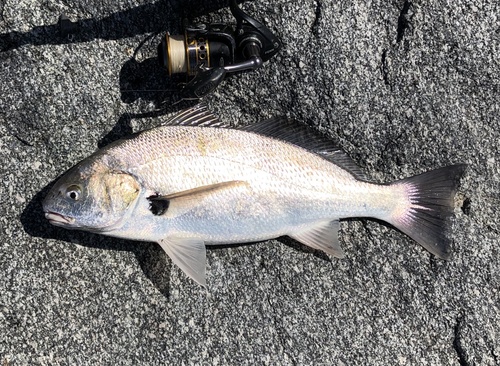
Spotfin Croaker
Roncador stearnsii
A powerful swimmer of the Pacific surf, the Spotfin Croaker is a coastal icon known for its metallic sheen and the distinctive 'ink-blot' spot at the base of its fin.
Quick Identification
Size
Typically 30-50 cm (12-20 inches) long, reaching a maximum of 69 cm (27 inches); weighs between 1-3 kg (2-6 lbs), though record specimens reach 4.5 kg (10 lbs).
Colors
Metallic bluish-gray or brassy on the upper back, transitioning to bright silver on the sides and white on the belly. Fins are generally yellowish or dusky.
Key Features
- Large, prominent black spot at the base of the pectoral fin
- Heavy-set body with a rounded, blunt snout
- No chin barbel (unlike the related Yellowfin Croaker)
- Two spines in the anal fin, with the second spine being very thick and long.
When You’ll See Them
Geographic range
Where Does the Spotfin Croaker Live?
The Spotfin Croaker is a native resident of the Eastern Pacific Ocean's temperate and subtropical waters. Its core range extends from Point Conception in California, USA, southward along the coast to San Juanico Bay in Baja California, Mexico. They are most commonly observed in the southern half of the Southern California Bight, where warm coastal waters and expansive sandy beaches provide the ideal environment for their foraging and spawning cycles.
Basemap © OpenStreetMap contributors
Behavior
The Spotfin Croaker is a social, schooling species known for its strong association with sandy bottom habitats. They are primarily benthic feeders, meaning they spend most of their time scouring the seafloor for food. Like other members of the Sciaenidae family, they possess a specialized swim bladder and muscles that allow them to produce a distinct 'croaking' or drumming sound, which is most frequently heard during the spawning season as a form of communication.
These fish are known to move into shallower water as the tide rises, often entering the heavy surf zone or venturing deep into bays and estuaries to forage. While they are relatively wary, they are a favorite among coastal observers and pier fishers. They do not exhibit complex social hierarchies but tend to congregate in large numbers where food is abundant, particularly near subtidal depressions or 'holes' in the sandy floor.
EverydayEarth exclusive
Camera Tips
To capture the Spotfin Croaker on camera, you will need a waterproof action camera or a specialized underwater 'drop cam' designed for marine environments. Because these fish are bottom-dwellers, the best results come from mounting your camera on a weighted base or a small tripod that can sit firmly on the sandy seafloor. Angle the lens slightly upward to catch the silver reflections of their scales as they pass by, or face it toward a patch of disturbed sand where they might forage.
Baiting is an effective way to bring Spotfin Croakers into the frame. Using a mesh 'chum bag' filled with crushed mussels, clams, or sand worms tied just in front of the camera's field of view will attract them as they follow the scent trail. Be sure to use a high frame rate (60fps or higher) to capture the quick, jerky movements they make when 'sifting' through the sand for food.
Timing is everything with this species. Use a camera with a schedule feature or a long-lasting battery to record during the two hours leading up to a high tide. The increased water volume allows them to move into shallower areas where light penetration is better, providing you with clearer, more colorful footage. During the late summer months, you may even capture larger spawning aggregations near the mouths of bays.
Similar Species
Species that look similar or are commonly confused with Spotfin Croaker.
Yellowfin Croaker
Has a small whisker-like barbel on the chin and lacks the large black spot on the pectoral fin.
White Croaker
Smaller overall with a more slender profile and no large black spot; often found in deeper water.
California Corbina
Lacks the black spot and has a much more elongated, cigar-shaped body with a single chin barbel.
Frequently Asked Questions
Record Spotfin Croaker at your habitat
Connect a camera to start building your own species record — AI identifies every visitor automatically.