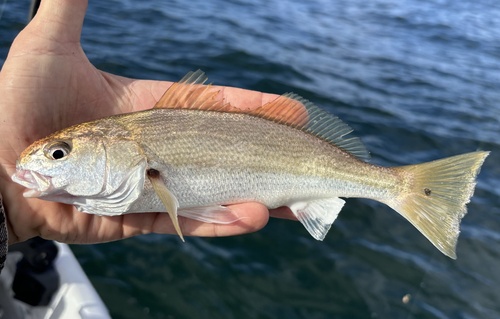
White Croaker
Genyonemus lineatus
Meet the 'King of the Pier,' a silvery bottom-dweller known for its unique vocalizations and social schooling habits. Found along the sandy reaches of the Eastern Pacific, the White Croaker is a fascinating study in coastal adaptation.
Quick Identification
Size
Typically 20–30 cm (8–12 inches) in length, reaching a maximum of 41 cm (16 inches) and weighing up to 1 kg (2.2 lbs).
Colors
Silvery-white to metallic body with brassy or brownish tints on the back; fins are often yellowish or dusky with a prominent small black spot at the base of the pectoral fin.
Key Features
- Small black spot at the base of the pectoral fin
- Subterminal mouth lacking a chin barbel
- 12 to 15 dorsal spines on a deeply notched fin
- Silvery, compressed body with a blunt snout
When You’ll See Them
Geographic range
Where Does the White Croaker Live?
Native to the Eastern Pacific coastline, the White Croaker is a true West Coast resident. Its range extends from the warm waters of Magdalena Bay in Baja California Sur, Mexico, northward along the entire California coast to Vancouver Island in British Columbia. While they can be found in the Pacific Northwest, their highest population densities occur south of San Francisco, where the temperate coastal waters provide the ideal sandy-bottom habitats they favor.
Basemap © OpenStreetMap contributors
Behavior
White Croakers are highly social fish that move in loose, shifting schools. They are primarily bottom-dwellers, spending most of their time hovering just above sandy or muddy substrates. Unlike some of their more aggressive relatives, they are relatively calm swimmers, using their sensitive snouts to forage through the sediment for hidden prey. They are famously known for the 'croaking' sound they produce by vibrating specialized muscles against their swim bladder, a behavior often used during social interactions or when startled.
While they are frequently found in deeper offshore waters, they are also common visitors to shallow bays, estuaries, and even the turbulent surf zone. They are well-adapted to coastal environments and are often the most abundant fish caught by pier anglers. Despite their proximity to human activity, they remain cautious but curious, often investigating disturbances in the sand that might reveal a potential meal.
EverydayEarth exclusive
Camera Tips
Capturing the White Croaker on camera requires an underwater setup, such as a GoPro or a dedicated drop-camera system. Because these fish stay close to the bottom, mount your camera on a weighted base or a tripod designed for marine use, positioning the lens roughly 6 to 12 inches above the seabed. Aim the camera at a slight downward angle toward an open sandy patch. In the murky waters of the Pacific, visibility is key—try to film on days with low swell and 'clear' water reports to avoid excessive backscatter from suspended sediment.
To attract a school to your camera's field of view, use a scent-based lure. A small mesh 'chum bag' filled with crushed mussels or frozen shrimp, secured just off-camera but within the scent trail, will bring White Croakers in to investigate. They are attracted to the disturbance of the sand, so if you can safely stir up the bottom before deploying the camera, it may trigger their natural foraging instincts. Ensure your camera is set to a high frame rate (60fps) to capture their subtle movements and the way they 'hover' over the sand.
Lighting is the biggest challenge in coastal photography. If you are filming at depths greater than 10 meters or under a pier, use a wide-beam video light with a warm color temperature to bring out the brassy highlights on the fish's scales. Without external light, the White Croaker will appear as a simple silver silhouette. If you are using an AI-powered camera with motion detection, set the sensitivity high, as their silvery bodies can sometimes blend into the shimmering reflections of the surface light hitting the sand.
Similar Species
Species that look similar or are commonly confused with White Croaker.
Yellowfin Croaker
Yellowfin Croaker has a small barbel on the chin and yellowish fins, but lacks the black spot at the pectoral fin base.
Queenfish
Queenfish are more elongated, have a larger mouth, and their two dorsal fins are widely separated compared to the White Croaker.
Spotfin Croaker
Spotfin Croakers have a much larger black spot on the pectoral fin and are generally deeper-bodied and heavier.
Frequently Asked Questions
Record White Croaker at your habitat
Connect a camera to start building your own species record — AI identifies every visitor automatically.