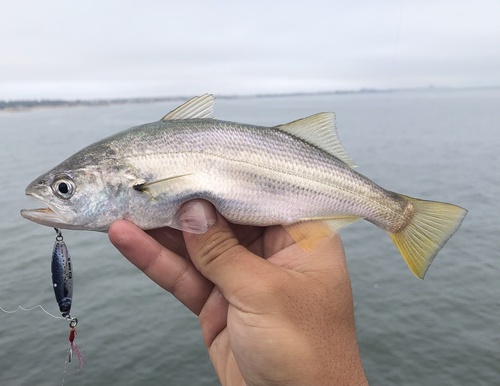
Queenfish
Seriphus politus
The Queenfish is the 'night owl' of the Pacific coast, a shimmering croaker that turns pier pilings into its personal playground. Known for its distinct dual dorsal fins and rhythmic underwater vocalizations, it is a fascinating species for anyone exploring the hidden wildlife of our shorelines.
Quick Identification
Size
Typically 6 to 10 inches (15–25 cm), with a maximum recorded length of 12 inches (30 cm).
Colors
Dusky blue to greenish-grey on the back, transitioning to bright silver sides and a white belly. Fins often display a distinct yellowish or golden hue.
Key Features
- Two widely separated dorsal fins
- Large mouth with a projecting lower jaw that extends past the eye
- Slender, compressed body shape
- No barbel on the chin
When You’ll See Them
Geographic range
Where Does the Queenfish Live?
North America's Eastern Pacific coastline serves as the native home for this species. Its core range is concentrated within the Southern California Bight, extending from Oregon in the north down through the entire length of Baja California, Mexico, and occasionally into the Gulf of California. While sightings have occurred as far north as British Columbia, they remain most abundant in the temperate and subtropical surf zones of the California coast.
Basemap © OpenStreetMap contributors
Behavior
As dusk approaches, these schools disperse, and individual Queenfish become active hunters. They belong to the croaker family (Sciaenidae), named for the 'croaking' sounds they produce by vibrating their swim bladders with specialized muscles. These sounds are most common during the spawning season and are thought to be a primary method of communication between individuals in the dark coastal waters.
EverydayEarth exclusive
Camera Tips
To successfully capture Queenfish on an AI-powered underwater camera, focus your efforts on 'shadowed' structures. These fish are strongly attracted to the dark areas beneath public piers, private docks, and kelp canopies during the day. Mounting your camera on a weighted tripod or a specialized piling clamp about 3 to 5 feet off the sandy bottom will place the lens right in their preferred hovering zone.
Because the Queenfish is primarily active at night, your camera's infrared (IR) capabilities are vital. If your camera setup allows for it, use an external IR illuminator to reduce 'backscatter'—the reflection of light off sand and plankton—which can often trigger false AI detections or cloud the image. For daytime shots, position the lens facing away from the sun to prevent silhouetting, allowing the camera to capture the subtle yellow tints on their fins and their silvery scales.
Baiting is an effective way to bring these curious fish into view. A small mesh 'chum bag' filled with crushed frozen shrimp or squid tied just within the camera's field of view will attract Queenfish as they begin their nightly hunt. Be sure to check the tide charts; the best footage is often captured during an incoming high tide when the water is clearer and the fish move closer to the shore to feed.
For the best AI identification results, set your camera to a high frame rate. Queenfish move with quick, darting motions when feeding or when spooked by larger predators. A faster shutter speed or higher FPS (frames per second) will ensure the AI can clearly distinguish the space between their two dorsal fins—the primary field mark for this species—without motion blur.
Similar Species
Species that look similar or are commonly confused with Queenfish.
Frequently Asked Questions
Record Queenfish at your habitat
Connect a camera to start building your own species record — AI identifies every visitor automatically.