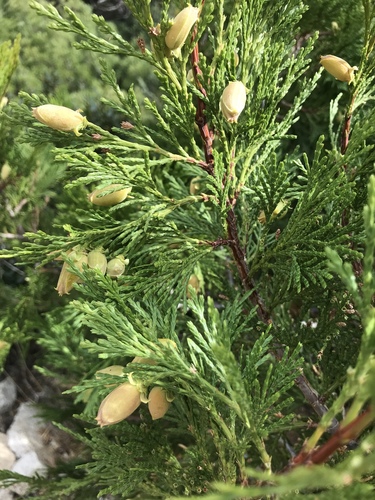
California incense-cedar
Calocedrus decurrens
The California incense-cedar is a titan of the West, recognizable by its aromatic, reddish bark and unique 'wine glass' foliage. A resilient survivor of fire and drought, it provides a year-round sanctuary for a diverse array of forest and backyard wildlife.
Quick Identification
Size
Height: 20–45 m (65–150 ft); Trunk diameter: 0.9–1.5 m (3–5 ft); maximum heights reaching 60 m (200 ft)
Colors
Rich cinnamon-red to reddish-brown bark; vibrant olive-green foliage; yellowish-brown seed cones
Key Features
- Scale-like leaves arranged in flattened sprays
- Branchlets resembling a series of stacked 'wine glasses'
- Deeply furrowed, fibrous reddish-brown bark
- Small, 1-inch cones that open to resemble a duck's bill
When You’ll See Them
Geographic range
Where Does the California incense-cedar Live?
This iconic conifer is native to the western regions of North America, primarily concentrated in the United States within the Sierra Nevada and Cascade ranges of California and Oregon. Its distribution extends eastward into the mountains of western Nevada and southward into the Sierra San Pedro Mártir of northern Baja California, Mexico. While its core natural range is restricted to these Mediterranean-climate regions, it has been successfully introduced as an ornamental species in temperate parks and gardens throughout Europe and the eastern United States.
Basemap © OpenStreetMap contributors
Behavior
The California incense-cedar is a slow-growing, long-lived conifer known for its incredible resilience and structural elegance. In the wild, it is a master of survival, featuring thick, fibrous bark that protects the tree's vital inner layers from the heat of forest fires. It is highly shade-tolerant when young, often spending decades in the understory of larger pines and firs before a gap in the canopy allows it to surge toward the sunlight.
In a backyard or garden setting, this species acts as a cornerstone of the local ecosystem. Its dense, evergreen foliage provides crucial thermal cover for birds and small mammals during harsh winter weather and nesting sites for specialized species like the Brown Creeper. While it doesn't move, it 'interacts' with humans through its aromatic wood—famously used for making pencils—and its role as a stately, drought-tolerant ornamental tree that provides privacy and wind protection.
EverydayEarth exclusive
Camera Tips
Capturing the life surrounding a California incense-cedar requires a strategy focused on the tree as a habitat hub. To showcase the tree’s unique textures, mount your camera 3 to 5 feet off the ground on a tripod or a neighboring tree, aiming at the main trunk. The deeply furrowed bark is a magnet for nuthatches, woodpeckers, and creepers searching for insects hidden in the crevices. Use a close-focus or macro setting if available to capture these small visitors against the cinnamon-colored bark.
For the best visual results, position the camera to face North or South. This prevents the harsh morning or afternoon sun from washing out the rich reddish tones of the bark or creating high-contrast shadows across the green foliage sprays. Since the incense-cedar is evergreen, it provides a magnificent backdrop during the winter months; the dark green 'wine-glass' leaves contrast beautifully with white snow, making it an ideal subject for winter-themed wildlife photography.
To capture mammal activity, look for a sturdy horizontal branch and mount a secondary camera nearby. Northern Flying Squirrels and owls often use these branches as launching pads or perches. Because the tree produces small, winged seeds in late summer and autumn, you can expect a spike in activity from squirrels and seed-eating birds. Setting your camera to 'Time-Lapse' mode can also reveal the slow, rhythmic movement of the branches in the wind and the changing light filters through the canopy, providing a complete picture of the tree's role in your backyard ecosystem.
Similar Species
Species that look similar or are commonly confused with California incense-cedar.
Frequently Asked Questions
Record California incense-cedar at your habitat
Connect a camera to start building your own species record — AI identifies every visitor automatically.