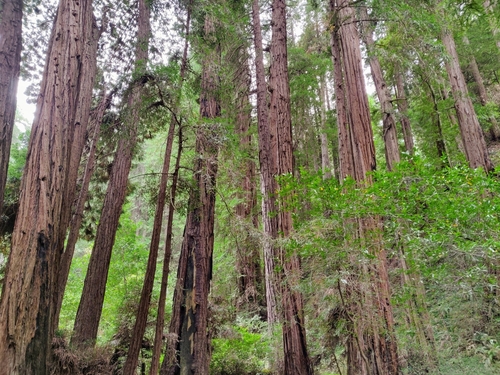
coast redwood
Sequoia sempervirens
The coast redwood is a living skyscraper, standing as the tallest tree on Earth and a silent witness to centuries of history. These evergreen giants create unique, fog-drenched ecosystems found nowhere else on the planet.
Quick Identification
Size
Height up to 115.9 m (380 ft); trunk diameter up to 8.9 m (29 ft); can weigh over 800 metric tons.
Colors
Cinnamon-red to deep brown fibrous bark; dark green needles with two silvery stomatal bands underneath.
Key Features
- World's tallest living tree species
- Fibrous, deeply furrowed reddish bark up to 12 inches thick
- Flat, needle-like leaves arranged in two flat rows
- Small, woody egg-shaped cones 0.75 to 1.25 inches long
When You’ll See Them
Geographic range
Where Does the coast redwood Live?
Native to the North American continent, the coast redwood thrives in a remarkably narrow strip along the Pacific Coast. Its natural range begins in the southwestern corner of coastal Oregon and extends southward for about 450 miles to the Santa Lucia Mountains in Monterey County, California. This species is rarely found more than 50 miles inland, as it depends on the cool, moist air and consistent summer fog provided by the Pacific Ocean to survive.
Basemap © OpenStreetMap contributors
Behavior
Coast redwoods are among the most resilient and long-lived organisms on the planet, with some individuals surviving for over 2,000 years. Their survival strategy is inextricably linked to the coastal fog of the Pacific Northwest. During the dry summer months, these giants use their massive canopy surface area to trap moisture from passing fog, which then drips down to the roots—a process known as 'fog drip' that can provide the tree with up to 40% of its annual water intake.
Socially, redwoods are fascinatingly interconnected. They possess shallow but wide-spreading root systems that can extend up to 100 feet from the trunk, intertwining with the roots of neighboring redwoods to provide mutual stability against high winds and floods. They are also unique among conifers for their ability to regenerate through sprouting; when a tree is damaged or felled, dormant buds at the base or along the trunk can grow into new, genetically identical clones, often forming 'fairy rings' around a central parent stump.
EverydayEarth exclusive
Camera Tips
When setting up a camera to capture a coast redwood, the primary challenge is the sheer scale of the subject. To capture the full stature of a backyard redwood, use a wide-angle lens and position the camera at a low angle looking upward. This 'worm's eye view' emphasizes the tree's height and the cathedral-like quality of the canopy. If your camera has a time-lapse mode, set it to take one photo per day at noon to document the subtle changes in light and the impressive speed of new growth during the spring and summer months.
Because redwoods are hotspots for biodiversity, placing your camera near the base of the tree can reveal a hidden world. Look for 'goosepens'—hollowed-out cavities caused by past fires. These serve as natural shelters for a variety of animals. Aim your camera at these openings to catch sightings of black bears, gray foxes, or even mountain lions that use the tree for cover. If you can safely mount a camera higher up in the branches, you may capture the Marbled Murrelet or the Northern Spotted Owl, both of which rely on old-growth redwood canopies for nesting.
Lighting in redwood groves is notoriously difficult, characterized by 'hot spots' of bright sun breaking through a dark canopy. Set your camera's exposure to 'Center-Weighted' or 'Spot' to avoid overexposing the scene when the sun hits the bark. For the most professional-looking shots, capture footage during foggy or overcast days. The moisture in the air acts as a natural diffuser, saturating the deep greens of the needles and the rich reds of the bark, while the fog provides a sense of depth and mystery that is quintessential to the redwood experience.
Similar Species
Species that look similar or are commonly confused with coast redwood.
Frequently Asked Questions
Record coast redwood at your habitat
Connect a camera to start building your own species record — AI identifies every visitor automatically.