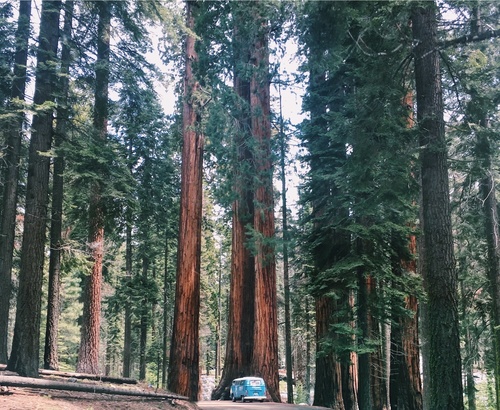
giant sequoia
Sequoiadendron giganteum
The undisputed heavyweights of the botanical world, Giant Sequoias are living ancient monuments that bridge the gap between the earth and the sky. Growing only on the western slopes of California's Sierra Nevada, these titans are built to survive fire, ice, and millennia of history.
Quick Identification
Size
Height of 50–85 m (164–279 ft); trunk diameter of 6–8 m (20–26 ft); weight up to 2,100 tons
Colors
Fibrous reddish-brown bark; blue-green evergreen foliage; woody brown cones
Key Features
- Massive, tapering trunk with thick, spongy reddish bark
- Scale-like needles arranged spirally around the shoot
- Large ovoid cones that stay green for up to 20 years
- Distinctive buttressed base on mature specimens
When You’ll See Them
Behavior
Giant Sequoias are the world's largest individual trees by volume, acting as the silent sentinels of the Sierra Nevada. Unlike most plants, their 'behavior' is defined by extreme longevity and a specialized relationship with fire. They are serotinous, meaning their cones often require the heat of a forest fire to dry out and release seeds into the nutrient-rich ash left behind. This dependency makes them a keystone species that literally shapes the ecosystem around them.
These giants create their own microclimates. Their massive canopies trap moisture from mountain fogs and provide critical nesting habitat for specialized wildlife like the Pacific fisher and various owl species. While they can live for over 3,000 years, they are surprisingly sensitive to groundwater changes. In a residential or garden setting (where they are often planted as ornamentals), they grow much faster than in the wild but lack the centuries-hardened bark that protects their mountain ancestors.
EverydayEarth exclusive
Camera Tips
Capturing a Giant Sequoia on a backyard or trail camera is a unique challenge because of their sheer scale. To truly appreciate the tree, avoid the standard eye-level mounting. Instead, use a wide-angle lens and position your camera at the base of the trunk tilted upward (the 'worm's eye view') to capture the cinnamon-colored bark receding into the sky. If you are monitoring a younger specimen in a backyard, a time-lapse setting is your best friend. Set the camera to take one photo every 24 hours at noon; over a year, you will see the remarkable 'pumping' motion of the branches as they respond to seasonal moisture and growth spurts.
For those interested in the wildlife that utilizes these trees, place your camera on a nearby structure or a smaller tree facing the Sequoia's trunk. Many species, such as the Douglas squirrel (chickaree), are frequent visitors because they are the primary seed dispersers for the Sequoia, chewing through the tough cones. Setting your trigger speed to the fastest possible setting is crucial here, as these squirrels move with lightning speed across the textured bark.
Night photography with a high-quality infrared flash can reveal the hidden world of nocturnal visitors like Northern Saw-whet Owls that nest in the trunk's cavities. Ensure your camera is set to a high-resolution video mode (1080p or 4K) to capture the detail of the fibrous bark, which often hosts unique insects and lichen. Because the bark is so thick and absorbent, traditional PIR (Passive Infrared) sensors might struggle to detect small animals against the tree's thermal mass; try to aim the sensor at a known 'runway' or a branch rather than just the flat bark.
Similar Species
Species that look similar or are commonly confused with giant sequoia.
Frequently Asked Questions
Record giant sequoia at your habitat
Connect a camera to start building your own species record — AI identifies every visitor automatically.