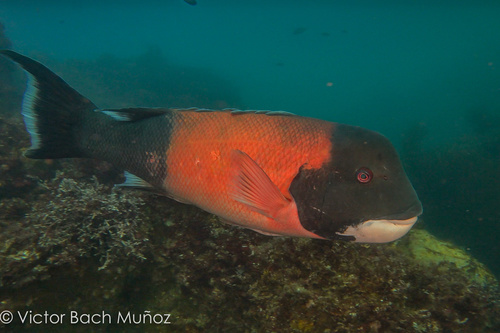
California Sheephead
Bodianus pulcher
A striking master of transformation, the California Sheephead is the vibrant guardian of the Pacific kelp forests. Known for its ability to change sex and its appetite for sea urchins, this charismatic fish is a favorite for underwater observers.
Quick Identification
Size
Up to 91 cm (36 inches) long and weighing as much as 16 kg (35 lbs)
Colors
Adult males have black heads and tails with a bright red or orange midsection and a white chin. Females are a solid pinkish-red color. Juveniles are bright red with a horizontal white stripe and black spots on their fins.
Key Features
- Distinctive three-colored body pattern in mature males
- Large, protruding canine-like teeth for crushing shells
- Fleshy lips and a prominent bulbous forehead on older males
- Robust, oval-shaped body built for navigating kelp forests
When You’ll See Them
Sightings on EverydayEarth
Mar 31, 2026
A group of bright orange Garibaldi swim actively through the kelp forest. A large California Sheephead enters from the right and cruises across the foreground, showing its characteristic white chin before disappearing off-screen to the left.
Aug 1, 2026
The lagoon is teeming with activity. A leopard shark with prominent dark spots swims across the foreground, while a large bat ray glides gracefully along the sandy bottom on the left. Several smaller fish, including a California sheephead, are seen navigating around the artificial reef structures in the center of the frame.
Jul 31, 2026
In a peaceful underwater scene, a Leopard Shark rests on the sandy floor near a coral outcropping. A variety of fish, including a male California Sheephead with its signature pink and black coloring, swim through the water column. On the far left, a Bat Ray glides gracefully past the camera.
Jul 31, 2026
A vibrant underwater scene in the lagoon shows a high level of activity. A Leopard Shark glides across the sandy bottom in the foreground, showing off its striking spotted pattern. In the background, a Green Sea Turtle swims slowly through the water column. Multiple Bat Rays glide gracefully through the scene, while various fish, including California Sheephead, dart around the coral-covered rock formations. Shifting shafts of sunlight filter down from the surface, illuminating the habitat.
Jul 27, 2026
The lagoon is active with various marine life. A Bat Ray glides along the sandy floor, while a beautifully spotted Leopard Shark swims prominently across the foreground. In the background, several other fish, including a California Sheephead, navigate around the central coral-like structures and artificial rockwork.
Jul 26, 2026
A vibrant underwater scene showing a variety of fish swimming among barnacle-encrusted pier pilings. Several Kelp Bass cruise near the structures, while bright orange Garibaldi and a large male California Sheephead move through the background. Schools of small, dark Blacksmith are scattered throughout the water column.
Geographic range
Where Does the California Sheephead Live?
Native to the Eastern Pacific Ocean, the California Sheephead is a signature species of the western North American coastline. Its primary range extends from the temperate waters of Monterey Bay in California southward to the warm-temperate Gulf of California in Mexico. This species is most densely concentrated around the Channel Islands and the rugged coastlines of Southern California and Baja California, where kelp forests are most productive.
Basemap © OpenStreetMap contributors
Recorded on EverydayEarth
Behavior
The California Sheephead is a fascinating, long-lived resident of the kelp forest that operates on a strict daytime schedule. These fish are diurnal, meaning they are active during the day and retreat into rocky crevices or caves at night to sleep. To protect themselves from predators while they slumber, they often secrete a mucus cocoon that masks their scent, similar to some species of parrotfish.
Perhaps their most incredible behavioral trait is their social structure and ability to change sex. All California Sheephead are born female, but as they grow larger and older, the dominant individuals in a group will transition into males. This process, known as protogynous hermaphroditism, is usually triggered by the disappearance of a dominant male from a reef, allowing the largest female to take his place and change her physiology and color to match her new role.
In terms of their role in the ecosystem, they are considered a keystone species. By feeding heavily on sea urchins, they prevent these spiny invertebrates from overgrazing the kelp, effectively acting as the guardians of the underwater forests. They are generally curious toward divers and can become quite bold if they realize humans are uncovering food sources like crushed urchins.
EverydayEarth exclusive
Camera Tips
Capturing the California Sheephead on camera requires an underwater setup, such as a GoPro or a specialized underwater trail camera, mounted to a stable surface like a pier piling or a weighted reef base. Because these fish are highly visual and curious, they are often drawn to the reflection of a camera lens. For the best results, position your camera at a depth of 15 to 30 feet near the edge of a kelp bed where the sunlight can still penetrate clearly, providing natural illumination for their vibrant red and black colors.
To attract a Sheephead into the frame, you can use the 'cracked urchin' method. If you are in an area where it is legal to do so, cracking open a purple sea urchin near the camera will almost instantly bring every Sheephead in the vicinity to the site. They are opportunistic foragers and have been known to follow divers around just waiting for a meal to be uncovered. If you are filming from a dock or a 'backyard' waterfront, try suspending a cage with bait inside to keep the fish in the field of view for longer periods.
Pay close attention to the time of day; these fish are strictly diurnal. Your best footage will be captured between 10 AM and 2 PM when the sun is directly overhead, as the light 'dancing' through the kelp fronds creates a dramatic backdrop for the Sheephead's striking colors. Set your camera to a high frame rate (60fps or higher) to capture the powerful, snapping motions of their jaws as they feed on hard-shelled prey.
Finally, ensure your camera housing is clean and free of salt spray or algae buildup. If you are leaving a camera submerged for an extended period, apply a small amount of non-toxic anti-fouling solution to the housing (but not the lens!) to prevent sea life from obscuring the view. Because Sheephead are territorial, you may find that the same large male visits your camera daily, providing an excellent opportunity for long-term behavioral study.
Similar Species
Species that look similar or are commonly confused with California Sheephead.
Frequently Asked Questions
Record California Sheephead at your habitat
Connect a camera to start building your own species record — AI identifies every visitor automatically.