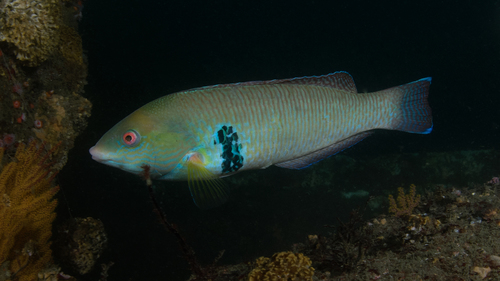
Rock Wrasse
Halichoeres semicinctus
A vibrant master of transformation, the Rock Wrasse brings a splash of color to the kelp forests and rocky reefs of the Pacific coast.
Quick Identification
Size
Typically 25-38 cm (10-15 inches) in length; weight is generally under 1 kg (2.2 lbs)
Colors
Males are greenish-gray with a prominent black vertical bar behind the pectoral fin; females and juveniles are reddish-brown with small black spots across the body
Key Features
- Prominent black vertical bar behind the pectoral fin (terminal males)
- Cigar-shaped, elongated body with a continuous dorsal fin
- Small, terminal mouth with protruding canine-like teeth
- Reddish-brown coloration with dark speckling in females
When You’ll See Them
Geographic range
Where Does the Rock Wrasse Live?
The Rock Wrasse is native to the Eastern Pacific coastal waters of North America. Its core range extends from Point Conception in California, United States, southward along the Pacific coast of Baja California and into the Gulf of California in Mexico. They are most abundant in the warm-temperate waters of the Southern California Bight, particularly around the Channel Islands.
Basemap © OpenStreetMap contributors
Behavior
The Rock Wrasse is a highly active and curious fish commonly encountered by divers and captured on underwater reef cameras. They are diurnal, meaning they are active during the daylight hours, and have a unique sleeping habit: as the sun sets, they dive into the sandy patches surrounding rocky reefs and bury themselves completely to avoid nocturnal predators.
These fish are protogynous hermaphrodites, a fascinating social structure where all individuals are born female. As they grow and social conditions allow, the largest and most dominant females undergo a biological transformation to become 'terminal phase' males. These males are territorial and can be seen patrolling their section of the reef, displaying their vibrant colors to attract mates and ward off rivals.
While generally solitary foragers, they are often seen following larger bottom-disturbing animals, such as rays or human divers, hoping to snatch up small invertebrates uncovered in the wake. They are generally bold and will often approach static camera setups to investigate the lens or any disturbed sediment.
EverydayEarth exclusive
Camera Tips
To capture the Rock Wrasse, you will need an underwater action camera or a specialized submersible trail camera. Position your camera at the 'ecotone'—the transition zone where a rocky reef meets a sandy patch. Because Rock Wrasse bury themselves in the sand at night and forage on the rocks during the day, this boundary is a high-traffic highway for them.
Lighting is your biggest challenge underwater. If your camera is deeper than 5 meters, use an external red filter or underwater video lights to bring out the vibrant greens and reds of the fish; otherwise, they will appear dull and blue. Set your camera to a high frame rate (60fps or higher) because wrasses move with quick, jerky pectoral fin movements that can appear blurry on lower settings.
To attract them to the frame, you can gently disturb a small patch of sand or turn over a single rock nearby (ensuring you return it to its original position). The Rock Wrasse is an opportunist and will swim directly into the field of view to check for exposed prey. In a backyard pier or dock setting, lowering a camera near kelp-covered pilings during high tide is often very productive.
Similar Species
Species that look similar or are commonly confused with Rock Wrasse.
Frequently Asked Questions
Record Rock Wrasse at your habitat
Connect a camera to start building your own species record — AI identifies every visitor automatically.