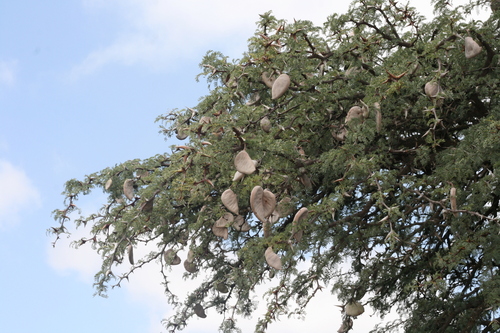
Camel Thorn
Vachellia erioloba
The Camel Thorn is the undisputed king of the Kalahari, a hardy giant that provides life-saving shade and food in Africa's most punishing environments. Recognizable by its iconic umbrella shape and ear-like pods, this tree is a bustling sanctuary for desert-dwelling wildlife.
Quick Identification
Size
Height: 6-18 metres (20-60 feet); Trunk diameter: up to 1 metre (3.3 feet)
Colors
Dark grey-to-black deeply fissured bark; grey-green leaves; bright yellow puffball flowers; grey-velvet seed pods
Key Features
- Large, ear-shaped woody seed pods covered in grey velvet
- Straight, paired white thorns up to 6cm long
- Deeply furrowed, dark grey-brown bark
- Wide, spreading umbrella-shaped canopy
- Small, bright yellow puffball flowers in clusters
When You’ll See Them
Sightings on EverydayEarth
Jun 18, 2026
A group of giraffes and a large herd of zebras are gathered at a waterhole in the morning light. The zebras are clustered near the water's edge, some drinking, while the giraffes stand tall among them, surveying the woodland surroundings.
Jun 8, 2026
A diverse group of animals congregates at the Tau Waterhole. A herd of African Savanna Elephants, including a young calf, stands at the muddy edge to drink. On the left, a Giraffe walks slowly across the background, its tall silhouette and patterned coat clearly visible. To the right of the elephants, several Plains Zebras are gathered, identifiable by their bold black-and-white stripes.
Geographic range
Where Does the Camel Thorn Live?
The Camel Thorn is a quintessentially Southern African species, flourishing in the continent's most arid and sun-drenched landscapes. Its primary range is centered in the deep, sandy soils of the Kalahari and Namib deserts, stretching across the vast majority of Namibia and Botswana. It is also a protected and iconic feature of South Africa’s northern provinces, with significant populations extending into southern Angola, western Zimbabwe, and reaching as far as Zambia and Eswatini.
Basemap © OpenStreetMap contributors
Behavior
The Camel Thorn is a 'keystone species' in the arid savannas of Southern Africa, meaning it plays a critical role in supporting the entire ecosystem. It is incredibly slow-growing but long-lived, with some specimens estimated to be over 1,000 years old. Its deep taproot can reach depths of up to 60 metres to access underground aquifers, allowing it to stay green even in the harshest droughts when other vegetation has withered.
This tree serves as a vital social and survival hub for wildlife. In the heat of the day, the temperature under its dense umbrella canopy can be several degrees cooler than the surrounding desert, attracting everything from lions to livestock. It also hosts massive colonial nests of Social Weavers, which can weigh over a ton and provide housing for hundreds of birds and various 'tenants' like Pygmy Falcons.
EverydayEarth exclusive
Camera Tips
Placement is everything when using the Camel Thorn as a focal point. Because it is a keystone species, it acts as a natural hub for all local wildlife seeking shade, food, or safety. For the best results, mount your camera approximately 1.5 to 2 meters high on a nearby post or a sturdy branch of a neighboring tree, angled toward the main trunk or the 'drip line' of the canopy. This height allows you to capture large browsers like giraffes or kudus as they nibble on the thorny branches, while still catching the activity of smaller mammals at the base.
The fallen pods are the ultimate natural 'bait.' During the dry season when the large, kidney-shaped pods drop to the ground, the area beneath a Camel Thorn becomes a high-traffic zone for gemsbok, eland, and even smaller rodents. Position your camera to face a clear patch of ground under the canopy where pods are concentrated. To avoid the harsh midday sun common in its native range, which can cause 'blown-out' images, try to orient your camera facing south to ensure even lighting across the subject throughout the day.
If your Camel Thorn hosts a massive Social Weaver nest, you have a unique opportunity. These 'bird apartment blocks' are hives of activity. Set your camera to a high-speed trigger or video mode and point it toward the entrance tunnels on the underside of the nest. You will not only capture the weavers but also the pygmy falcons or snakes that frequently visit these colonies. For night shots, the dark, textured bark provides an excellent backdrop for the eyes of nocturnal species like genets or owls that use the branches as hunting perches.
Similar Species
Species that look similar or are commonly confused with Camel Thorn.
Frequently Asked Questions
Record Camel Thorn at your habitat
Connect a camera to start building your own species record — AI identifies every visitor automatically.