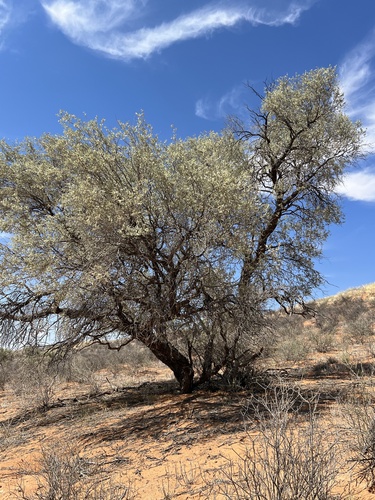
Grey Camel Thorn
Vachellia haematoxylon
The silvery sentinel of the Kalahari, the Grey Camel Thorn is a master of desert survival. Its velvety foliage and nutrient-rich pods make it a vital oasis for everything from tiny weavers to towering giraffes.
Quick Identification
Size
Small to medium tree, typically 3-10m (10-33ft) tall, with a canopy width often exceeding its height.
Colors
Silvery-grey to blue-grey foliage; bark is grey-brown and deeply fissured; heartwood is a distinct deep reddish-brown.
Key Features
- Fine, velvety grey hairs covering leaves and pods
- Pairs of straight, slender white spines up to 6cm long
- Bright yellow, globose (ball-shaped) flower heads
- Velvety, sickle-shaped grey seed pods
- Deep red heartwood from which its name 'haematoxylon' (blood wood) is derived
When You’ll See Them
Geographic range
Where Does the Grey Camel Thorn Live?
The Grey Camel Thorn is native to the arid interior of Southern Africa, predominantly anchored in the Kalahari Desert region. Its core population thrives within the Northern Cape of South Africa, spreading north into the southwestern parts of Botswana and the central and southeastern regions of Namibia. It is a specialist of sandy substrates, rarely found in rocky or clay-heavy soils.
Basemap © OpenStreetMap contributors
Behavior
The Grey Camel Thorn is a slow-growing, highly resilient keystone species of the Kalahari ecosystem. It is an extremophile of sorts, adapted to survive in areas with minimal rainfall and dramatic temperature swings ranging from sub-zero winter nights to scorching summer days. Its root system is particularly impressive, featuring a deep taproot that can descend dozens of metres to reach subterranean aquifers, allowing it to remain green when other vegetation has withered.
In the wild, this tree functions as a 'biological desert resort.' It provides a microclimate of shade that can be several degrees cooler than the surrounding open sand, attracting a wide variety of fauna. It also plays a critical role in soil health; as a legume, it fixes nitrogen, enriching the nutrient-poor sands around its base and allowing specialized grasses and shrubs to flourish in its 'fertility island.'
EverydayEarth exclusive
Camera Tips
When monitoring a Grey Camel Thorn with a trail camera, the best strategy is to focus on the 'shade footprint.' In the heat of the Kalahari day (11 AM to 4 PM), the north or south side of the tree (depending on the season) becomes a magnet for large mammals like gemsbok, springbok, and even predators like lions or leopards seeking relief from the sun. Mount your camera on a sturdy stake or a neighboring shrub about 1 metre off the ground, angled toward the trunk to capture these resting animals.
To capture the fascinating avian life, consider a high-angle mount. Many Grey Camel Thorns host the massive communal nests of Sociable Weavers. If you can safely mount a camera on a high branch or a nearby pole overlooking these hay-stack-like structures, you can document the constant activity of weavers, as well as their 'tenants' like Pygmy Falcons or specialized nest predators like Cape Cobras and Boomslangs.
During the late summer and autumn (January to May), focus your lens on the ripening seed pods. These nutrient-dense pods are a critical food source and will attract giraffes, kudu, and even smaller livestock. Set your camera to a multi-shot burst mode; giraffes have a very specific way of using their prehensile tongues to strip pods while avoiding the thorns, and a burst of photos is the only way to catch this fast-moving behavior in high detail.
Similar Species
Species that look similar or are commonly confused with Grey Camel Thorn.
Frequently Asked Questions
Record Grey Camel Thorn at your habitat
Connect a camera to start building your own species record — AI identifies every visitor automatically.