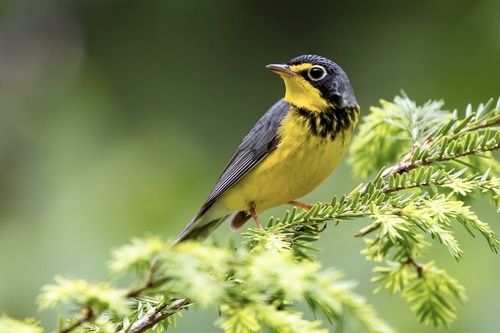
Canada Warbler
Cardellina canadensis
Known for its striking black-streaked 'necklace' and vibrant yellow breast, the Canada Warbler is a master of the forest undergrowth. This agile long-distance traveler brings a splash of boreal color to shaded backyards during its incredible cross-continental journey.
Quick Identification
Size
Length: 12–15 cm (4.7–5.9 in); Wingspan: 20–22 cm (7.9–8.7 in); Weight: 9–13 g (0.3–0.5 oz)
Colors
Bright yellow throat and belly, blue-gray upperparts, and a bold white eye-ring. The male features a prominent 'necklace' of black streaks across the chest, while the female's necklace is fainter and more grayish.
Key Features
- Distinctive necklace of black streaks on a yellow chest
- Bold white eye-ring or 'spectacles'
- Blue-gray back and wings with no wing bars
- Yellow 'lores' (area between eye and bill)
When You’ll See Them
Geographic range
Where Does the Canada Warbler Live?
The Canada Warbler is a remarkable long-distance traveler, native to the Western Hemisphere with a breeding range that spans the vast boreal forests of Canada and the northeastern United States, extending south through the Appalachian Mountains. These birds are among the last migrants to arrive on their northern breeding grounds in late spring and are frequently the first to depart in late summer. During the winter, they migrate thousands of miles to northern South America, where they primarily inhabit the mid-elevation subtropical forests of the Andes Mountains in countries like Colombia, Ecuador, and Peru.
Basemap © OpenStreetMap contributors
Behavior
Despite their bright yellow plumage, they can be surprisingly elusive, preferring the shadows of thick thickets and moist woodlands. They are highly active and nervous birds, often flicking their wings and tails as they move through the brush. During migration, they may join mixed-species flocks, but they remain fiercely territorial on their breeding grounds, where the males sing a rich, complex song that usually begins with a sharp, explosive chip note.
EverydayEarth exclusive
Camera Tips
While Canada Warblers won't visit traditional seed feeders, they are highly attracted to water. A solar-powered birdbath with a 'wiggler' or a small recirculating waterfall is a magnet for these birds, especially during the peak of spring migration in May or late summer in August. Position your camera about 3 to 5 feet from the water source. The sound of moving water in a quiet, shaded backyard corner is the single best way to bring this 'skulking' species into clear view of your lens.
Timing is everything with this species. They are most active in the very early morning hours, so ensure your camera is set to its highest sensitivity during the first three hours after sunrise. If you are in their breeding range, look for 'shrubby' areas near wetlands. In a suburban setting, maintaining a 'wild' corner of your yard with native shrubs like dogwood or serviceberry will increase your chances of a fly-by. Set your camera to 'Burst Mode' or a short 10-second video clip to capture their quick, nervous movements and distinctive tail-flicking behavior which makes identification much easier in post-capture review.
Similar Species
Species that look similar or are commonly confused with Canada Warbler.
Magnolia Warbler
Magnolia Warblers have prominent white wing bars and yellow rumps, which the Canada Warbler lacks.
Wilson's Warbler
Wilson's Warblers are all-yellow without the gray back, and males have a solid black 'cap' rather than a necklace.
Kentucky Warbler
Kentucky Warblers have a solid black 'sideburn' patch and lack the speckled necklace of the Canada Warbler.
Frequently Asked Questions
Record Canada Warbler at your habitat
Connect a camera to start building your own species record — AI identifies every visitor automatically.