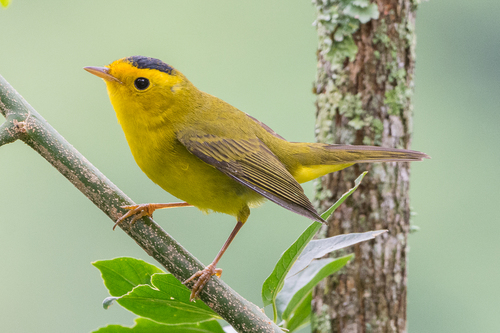
Wilson's Warbler
Cardellina pusilla
A tiny spark of golden energy, the Wilson's Warbler is easily recognized by the male's dapper black cap and his restless, twitching tail. These migratory sprites bring a flash of sunshine to the backyard undergrowth every spring and fall.
Quick Identification
Size
Length: 4.3–4.7 in (11–12 cm); Wingspan: 5.5–6.7 in (14–17 cm); Weight: 0.2–0.3 oz (5–10 g)
Colors
Luminous lemon-yellow face and underparts; olive-green wings, back, and tail. Adult males feature a distinct, glossy black crown patch, which is smaller or olive-toned in females.
Key Features
- Glossy jet-black crown (males)
- Uniformly bright yellow underparts with no streaking
- Constant flicking or wagging of a long, slim tail
- Large, dark 'beady' eyes that stand out on a plain yellow face
When You’ll See Them
Behavior
Wilson's Warblers are high-energy acrobats that rarely stay still for more than a few seconds. Unlike many of their warbler cousins who prefer the high forest canopy, these birds are masters of the understory and shrub layer. They are famous for their nervous habit of twitching their tails in a circular or side-to-side motion while they hop through dense foliage in search of a meal.
These birds are highly territorial during the breeding season but become part of mixed-species foraging flocks during migration. You will often see them 'hover-gleaning,' a technique where they hover briefly in front of a leaf to snatch an insect before moving to the next perch. They are generally bold and curious, sometimes approaching humans who remain quiet and still in the garden.
EverydayEarth exclusive
Camera Tips
To capture a Wilson's Warbler on camera, you must focus your efforts on the 'shrub zone.' Since these birds rarely visit traditional seed feeders, your best strategy is to place your camera near a moving water source. A shallow birdbath with a solar-powered bubbler or a small backyard waterfall is like a magnet for them. Position the camera low to the ground—about 18 to 36 inches high—aimed at a 'prepping' branch: a small, bare twig near the water where the bird is likely to land and scan the area before hopping down to bathe.
Because Wilson's Warblers are incredibly fast and their signature tail-flicking can cause motion blur, lighting and shutter speed are critical. Try to place your camera in a spot that receives bright, filtered morning light. Avoid deep shadows, which can make the bird's yellow feathers look muddy. If your AI camera has adjustable settings, prioritize a high shutter speed or 'Sports Mode' to freeze their rapid movements. A 'Burst Mode' setting is ideal here, as it increases your chances of catching that perfect moment when the male's black cap is clearly visible.
Seasonality is key for backyard observers. Unless you live in their specific breeding or wintering ranges, you will only see these birds during a narrow window in the spring and fall. Increase your camera's sensitivity and check your footage daily during May and September. If you have native shrubs like Elderberry or Willow, place your camera at the edge of the foliage. These plants host the insects Wilson's Warblers crave, making them the perfect natural backdrop for high-quality wildlife captures.
Similar Species
Species that look similar or are commonly confused with Wilson's Warbler.
Frequently Asked Questions
Record Wilson's Warbler at your habitat
Connect a camera to start building your own species record — AI identifies every visitor automatically.