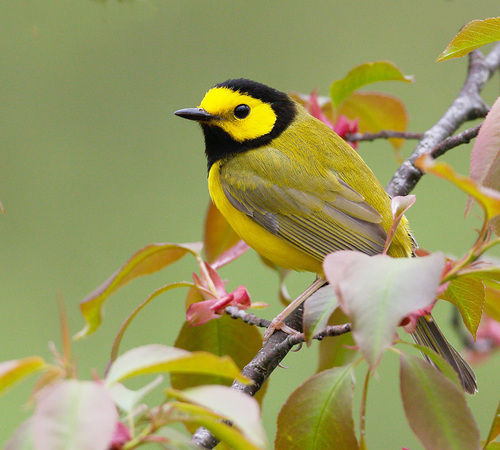
Hooded Warbler
Setophaga citrina
With its radiant yellow face peering out from a dramatic black hood, this stunning songbird is a jewel of the forest understory. Famous for its constant tail-flicking and soulful song, the Hooded Warbler is a favorite for backyard birders with wooded lots.
Quick Identification
Size
Length: 12-13 cm (4.7-5.1 in); Wingspan: 17.5-18.5 cm (6.9-7.3 in); Weight: 9-12 g (0.3-0.4 oz)
Colors
Males have a bright yellow face and underparts framed by a jet-black hood and throat; females are olive-green above and yellow below, often with a faint dark crown.
Key Features
- Striking black hood surrounding a yellow face (males)
- Constant tail-flicking that reveals white outer tail feathers
- Bright yellow underparts with olive-green wings and back
- Lacks wing bars or eye rings
When You’ll See Them
Geographic range
Where Does the Hooded Warbler Live?
Native to the North American continent, the Hooded Warbler is a quintessential summer resident of the eastern United States. Its core breeding range extends from the Gulf Coast north to the Great Lakes and into the southernmost tip of Ontario, Canada. As a migratory species, it travels across the Gulf of Mexico each autumn to spend the winter months in the lush tropical forests and coastal scrub of Mexico, Central America, and the Caribbean islands.
Basemap © OpenStreetMap contributors
Behavior
The Hooded Warbler is a high-energy bird of the forest understory, characterized by its restless nature and a unique habit of constantly spreading and closing its tail. This 'flashing' behavior exposes white outer tail feathers, which is believed to startle insects into movement, making them easier for the bird to catch. Unlike many other warblers that forage high in the tree canopy, this species spends most of its time within a few feet of the ground.
They are highly territorial during the breeding season and are known for their loud, clear, whistling song that sounds like 'wheeta-wheeta-whee-tee-o.' While they can be secretive in dense foliage, they are not particularly shy of humans and will often curiousy investigate noises in their territory. In the winter, they maintain individual territories in tropical forests, with males and females often occupying different habitat types.
EverydayEarth exclusive
Camera Tips
Capturing a Hooded Warbler on camera requires focusing on the lower strata of your backyard or woodland. Unlike many birds that visit feeders, these warblers are rarely interested in seeds. Instead, place your camera near a low-profile water feature. A ground-level bird bath with a solar-powered dripper or small fountain is the ultimate magnet for this species, as the sound of moving water is irresistible to migrating warblers.
Mount your camera low to the ground—ideally between 12 and 24 inches high—and aim it toward a shaded area with dense ferns or shrubbery. Hooded Warblers love 'edge' habitats and forest gaps, so if you have a spot where your lawn meets a wooded area, that is a prime location. Use a fast shutter speed or a high-frame-rate video setting to catch their rapid tail-flicking, which is their most diagnostic behavior on camera.
Because they are most active in the early morning, ensure your camera has a wide aperture or good low-light sensitivity to handle the dim light of the forest understory. If you are using an AI-powered camera, set it to trigger on 'Small Birds' and look for the tell-tale white flashes in the tail. During the spring migration in April and May, you are most likely to catch them as they return to their breeding grounds and are most vocal and active.
Similar Species
Species that look similar or are commonly confused with Hooded Warbler.
Wilson's Warbler
Much smaller; has a small black cap rather than a full hood and bib; lacks white tail spots.
Kentucky Warbler
Has a black 'sideburn' or mask rather than a full hood; features a yellow eye-ring and no white in the tail.
Common Yellowthroat
Male has a black 'bandit mask' across the eyes rather than a hood that encircles the face.
Frequently Asked Questions
Record Hooded Warbler at your habitat
Connect a camera to start building your own species record — AI identifies every visitor automatically.