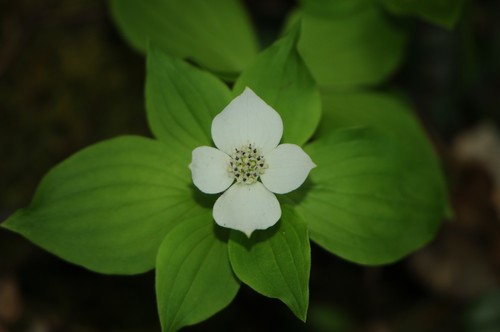
Canadian bunchberry
Cornus canadensis
The Canadian bunchberry is the sparkling jewel of the northern forest floor, known for its elegant white 'blooms' and brilliant red fruit. This tiny relative of the giant dogwood tree is a marvel of biological engineering, holding the record for the fastest-moving floral parts in nature.
Quick Identification
Size
Height of 10–25 cm (4–10 in); leaf whorls typically 5–12 cm (2–5 in) in diameter
Colors
Creamy white bracts (often mistaken for petals); deep forest green leaves; bright scarlet-red berry clusters
Key Features
- Whorl of 4-6 oval, deeply veined leaves
- Four white petal-like bracts surrounding a cluster of tiny flowers
- Bright red edible berry clusters in late summer
- Low-growing, carpet-like creeping habit
When You’ll See Them
Geographic range
Where Does the Canadian bunchberry Live?
Native to the vast temperate and boreal regions of the Northern Hemisphere, the Canadian bunchberry is most prolific across the North American continent. It blankets the forest floors from Alaska and across every Canadian province to Newfoundland, dipping down into the northern United States, including the Pacific Northwest, the Great Lakes region, and the higher elevations of the Appalachian Mountains. Beyond North America, this resilient species is also found in the cool, moist woodlands of Eastern Asia, specifically in Japan, Korea, and parts of Eastern Russia.
Basemap © OpenStreetMap contributors
Behavior
The Canadian bunchberry is a master of the woodland floor, behaving more like a slow-moving green tide than a static plant. It spreads primarily through a system of underground rhizomes, which allow it to form dense, lush carpets that can cover several square meters. This growth pattern is highly effective at outcompeting smaller mosses and stabilizing the acidic soil of the forest floor.
While it appears tranquil, the bunchberry is famous for having the fastest-moving parts in the plant kingdom. Its tiny central flowers are equipped with a 'trebuchet' mechanism that, when triggered by a pollinator's touch, launches pollen into the air in less than 0.5 milliseconds. This high-speed adaptation ensures its genetic material can reach traveling insects or be carried by the wind even in the still air of a dense forest understory.
Throughout the seasons, its behavior changes to support local wildlife. In the spring, its white bracts act as a beacon for pollinators, while in late summer and autumn, the plant focuses its energy on ripening its 'bunch' of berries. These berries are a critical high-energy food source for migrating birds and small mammals preparing for winter, creating a hub of animal activity around the plant's low-profile canopy.
EverydayEarth exclusive
Camera Tips
To capture the best images of Canadian bunchberry with a backyard or trail camera, you need to get down to its level. Set your camera on a low-profile mount or a beanbag just 6 to 10 inches off the ground. An upward-tilted angle can make a single plant look like a majestic forest giant, while a direct overhead shot is perfect for highlighting the geometric symmetry of the whorled leaves and the four white bracts.
Lighting is your biggest challenge in the dense forest habitats where bunchberry thrives. AI-powered cameras with high dynamic range (HDR) are ideal for handling the 'dappled' light that filters through the tree canopy. If possible, place your camera in a spot where a gap in the trees allows for 'spotlight' sun during the mid-morning hours, which will make the white flowers or red berries pop against the dark green leaves and forest floor.
Because the Canadian bunchberry is a favorite snack for wildlife, you can use it as a natural 'lure.' Focus your camera on a particularly healthy patch of berries in August. Birds like the Hermit Thrush and small mammals like chipmunks or red squirrels are frequent visitors. Set your camera to a fast trigger speed or high-frame-rate video mode to capture these quick-moving visitors as they forage among the leaves.
Consider using a time-lapse setting over the course of the spring. The transition from the tight green buds to the wide-open white bracts is a spectacular process that often occurs over just a few warm days. If you are using an AI camera with macro capabilities, try to focus on the very center of the flower cluster; you might be lucky enough to capture the 'pollen explosion' triggered by a visiting bee or fly.
Similar Species
Species that look similar or are commonly confused with Canadian bunchberry.
Frequently Asked Questions
Record Canadian bunchberry at your habitat
Connect a camera to start building your own species record — AI identifies every visitor automatically.