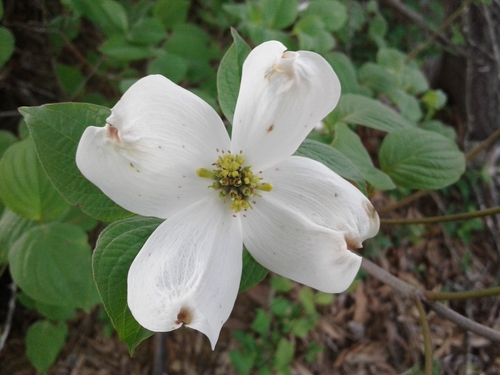
flowering dogwood
Cornus florida
A crown jewel of the North American forest, the flowering dogwood transforms from a cloud of spring white to a vibrant autumnal burgundy. This elegant understory tree is more than just a pretty face; it is a vital lifeline for backyard birds and pollinators.
Quick Identification
Size
Typically 15-30 feet (4.5-9 meters) tall with a similar spread; trunk diameter of 6-12 inches (15-30 cm).
Colors
Showy white or pink bracts; dark green summer leaves turning deep reddish-purple in fall; bright red winter berries; grey-brown bark.
Key Features
- Four-pointed white or pink petal-like bracts with distinct notched tips
- Blocky grey bark resembling alligator skin
- Opposite, simple leaves with veins that curve toward the tip
- Clusters of small, bright red oval berries in autumn
When You’ll See Them
Behavior
The flowering dogwood is a quintessential understory tree that defines the visual landscape of the eastern United States. Rather than reaching for the highest canopy, it thrives in the dappled sunlight beneath larger oaks and maples. In a backyard setting, it acts as a central hub for biodiversity, providing structural nesting sites for songbirds and a reliable food source during critical migratory windows.
While famous for its spring display, the tree's "behavior" is best observed through its seasonal transitions. In the spring, the tree produces small, inconspicuous yellow flowers surrounded by four large, showy bracts that lure in pollinators. By late summer and autumn, the tree focuses its energy on producing nutrient-dense red drupes (berries) that are a high-fat fuel source for birds preparing for winter or migration. Its interaction with humans is largely ornamental, though it requires specific care to thrive in suburban environments where soil compaction and heat stress are common.
EverydayEarth exclusive
Camera Tips
To capture the full majesty of a flowering dogwood, camera placement is everything. For those using trail cameras to monitor wildlife visitors, mount your camera at a height of 5 to 7 feet, angled slightly downward toward a branch heavy with berries. During the autumn months, this setup is perfect for catching Cedar Waxwings, Northern Cardinals, and Tufted Titmice as they feast on the fruit. If you are focusing on the tree's structure, a lower mount point (3 feet) aimed at the trunk will highlight the unique 'alligator skin' texture of the bark, which is particularly striking in the snow.
Lighting is your biggest challenge and best friend with this species. Dogwoods often grow in 'dappled' light which can trick a camera's auto-exposure, leading to blown-out white bracts or overly dark shadows. If your camera allows for exposure adjustment, slightly underexpose during the spring bloom to preserve the delicate detail in the white bracts. Position the camera to the south of the tree to ensure the blooms are front-lit by the midday sun, or use a side-angle for early morning shots to capture the dew on the leaves.
For a truly unique project, use your camera’s time-lapse mode during the late transition of March into April. Set the interval to one photo every 2-4 hours. This allows you to create a condensed video of the bracts expanding from tight grey buds into full white clouds. In the fall, a similar time-lapse set to one photo per day at noon can document the spectacular color shift from deep green to brilliant burgundy. Make sure to use a high-capacity SD card and a fresh battery pack, as these seasonal transitions can take several weeks to complete.
Similar Species
Species that look similar or are commonly confused with flowering dogwood.
Frequently Asked Questions
Record flowering dogwood at your habitat
Connect a camera to start building your own species record — AI identifies every visitor automatically.