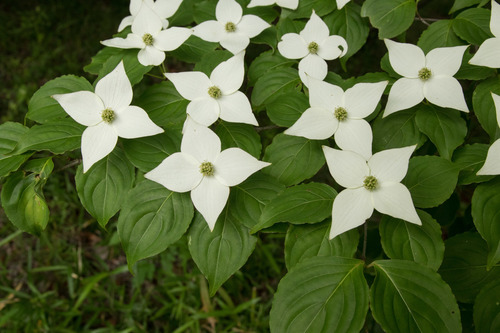
kousa dogwood
Cornus kousa
A four-season showstopper, the Kousa Dogwood lights up backyards with starry white blooms and provides a late-summer feast for colorful songbirds.
Quick Identification
Size
Height of 8–12 meters (26–39 feet) with a spread of 4–8 meters (15–25 feet)
Colors
Dark green summer foliage turning reddish-purple in fall; creamy white to pale pink star-shaped flower bracts; pinkish-red raspberry-like fruits; tan and gray exfoliating bark
Key Features
- Pointed creamy-white flower bracts appearing after leaves
- Edible pinkish-red bumpy fruit resembling a round raspberry
- Exfoliating, mottled bark on mature trunks
- Opposite, ovate leaves with distinct wavy margins
When You’ll See Them
Behavior
The Kousa Dogwood is a slow-to-moderate growing deciduous tree that offers high ornamental value through all four seasons. Unlike the native Flowering Dogwood, the Kousa blooms later in the spring, usually in June, after its leaves have fully emerged. This provides a lush green backdrop for its hundreds of star-shaped white bracts. As the seasons progress, it develops distinctive round, knobby red fruits that are a major draw for local fauna.
In the ecosystem of a backyard, this tree acts as a hub for biodiversity. It provides dense nesting cover for songbirds and serves as a reliable food source in late summer and early autumn. While it is an introduced species from East Asia, it is well-behaved in most suburban environments and is prized for its resistance to the diseases that often plague native dogwoods, such as anthracnose.
EverydayEarth exclusive
Camera Tips
To capture the best of a Kousa Dogwood, position your camera about 5-7 feet off the ground and angled slightly downward toward the canopy if you are targeting bird activity. During the late summer fruiting stage, the tree becomes a magnet for Cedar Waxwings, Northern Cardinals, and Gray Catbirds. Setting your camera to 'Photo + Video' mode with a short 10-second trigger interval will help you catch the fast-moving birds as they pluck the heavy, dangling fruits.
For those interested in nocturnal visitors, place a secondary camera at a lower height (12-18 inches) focused on the ground beneath the tree. The Kousa Dogwood drops a significant amount of overripe fruit, which attracts nocturnal scavengers like raccoons, Virginia opossums, and even white-tailed deer. Use a high-quality infrared flash to capture clear nighttime footage without spooking the animals as they feast on the fallen 'raspberries.'
Time-lapse mode is particularly effective for this species. Set your camera to take one photo every 4-6 hours from late May through June to document the transition from green buds to a full white canopy. For the most dramatic visual results, ensure the camera is facing north or south to avoid direct lens flare from the sun, which can wash out the delicate white of the bracts or the deep reds of the autumn leaves.
Similar Species
Species that look similar or are commonly confused with kousa dogwood.
Frequently Asked Questions
Record kousa dogwood at your habitat
Connect a camera to start building your own species record — AI identifies every visitor automatically.