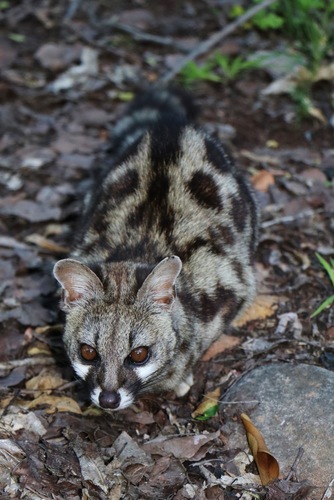
Cape Genet
Genetta tigrina
With its leopard-like spots and elegant, ringed tail, the Cape Genet is the ultimate backyard phantom. This agile South African endemic turns suburban gardens into its personal hunting ground under the cover of night.
Quick Identification
Size
Head-body 45–60 cm (18–24 in), tail 40–50 cm (16–20 in); weight 1.5–3.2 kg (3.3–7 lbs)
Colors
Pale grey to yellowish-white fur with large, dark brown to black spots; tail is ringed black and white with a characteristic white tip.
Key Features
- Large dark spots on a pale coat
- Long, bushy tail with 7-8 black rings and a white tip
- Prominent black-and-white mask with white patches under the eyes
- Slender, cat-like body with short limbs
When You’ll See Them
Geographic range
Where Does the Cape Genet Live?
The Cape Genet is native to the southern tip of the African continent, found exclusively within the borders of South Africa, Lesotho, and Eswatini. Its distribution is closely tied to high-rainfall areas, stretching from the Western Cape's coastal forests through the Eastern Cape and KwaZulu-Natal, reaching into the moist highveld and mist-belt regions of the northern provinces. It is a true South African endemic, avoiding the arid Karoo and Kalahari regions where its cousin, the Common Genet, is more prevalent.
Basemap © OpenStreetMap contributors
Behavior
The Cape Genet is a shy, solitary, and strictly nocturnal mammal. While they are master climbers that spend much of their time in the canopy to avoid predators or rest, they are primarily terrestrial hunters. They are highly territorial, with individuals maintaining large home ranges that they mark with scent glands located near the tail. You will rarely see more than one genet at a time, unless it is a mother with her kits or a pair during the brief mating season.
In human-dominated landscapes, Cape Genets have shown remarkable adaptability. They often take up residence in the lofts of houses or in quiet outbuildings, emerging at dusk to patrol garden fences and walls. They are generally peaceful neighbors, though their presence is usually signaled by their distinctive 'coughing' calls or the occasional discovery of their latrines. Because they are efficient predators of mice and rats, many homeowners welcome them as natural pest control.
EverydayEarth exclusive
Camera Tips
To catch a Cape Genet on camera, focus on 'wildlife highways' such as the tops of garden walls, sturdy horizontal tree branches, or along the edges of dense shrubbery. These animals prefer to move where they have quick access to cover. Mount your camera at a low height of 30 to 50 centimeters if aiming at a ground trail, or secure it to a tree limb about 1.5 meters up to catch them in their arboreal element.
Scent lures are incredibly effective for this species. A small amount of pungent wet cat food or a smear of sardines placed in a perforated container will often cause a genet to stop and investigate, giving you a perfect still shot. If you prefer a mess-free option, even the scent of vanilla essence or a commercial predator lure can pique their curiosity. Because they are nocturnal, a camera with 'No-Glow' or 'Low-Glow' infrared LEDs is vital to prevent startling the animal and causing it to flee.
During the summer months, keep an eye out for increased activity as females may be foraging more frequently to support growing kits. If you have a pond or water feature, position your camera there; genets are frequent drinkers and will also hunt for frogs or insects near the water's edge. Ensure your trigger speed is set to its fastest setting, as genets are fluid, fast-moving animals that can easily blur a slow-reacting camera.
Similar Species
Species that look similar or are commonly confused with Cape Genet.
Frequently Asked Questions
Record Cape Genet at your habitat
Connect a camera to start building your own species record — AI identifies every visitor automatically.