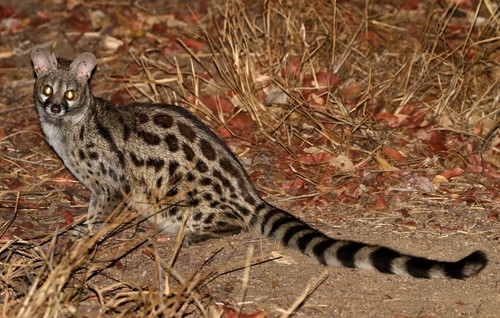
Rusty-spotted Genet
Genetta fieldiana
The Rusty-spotted Genet is the 'spotted phantom' of the African night, a lithe and elegant predator that moves through the shadows with silent precision. With its striking ringed tail and leopard-like spots, it is one of the most rewarding species to capture on a backyard trail camera.
Quick Identification
Size
Head and body 42-52 cm (16-20 in); tail 40-54 cm (15-21 in); weight 1.3-3 kg (2.9-6.6 lbs)
Colors
Pale yellowish-grey coat with distinct rusty-brown or reddish spots arranged in rows; tail features 8-12 dark rings with a pale tip; black 'tear' marks below the eyes.
Key Features
- Slender, cat-like body with a pointed muzzle and large, rounded ears
- Rusty-red to dark mahogany spots on a light background
- Long, bushy tail with black-and-white rings
- Short legs with semi-retractable claws for expert climbing
When You’ll See Them
Sightings on EverydayEarth
Jun 29, 2026
Under the cover of night, two Rusty-spotted Genets are resting and grooming in a clearing. In the foreground, a large rhinoceros lies still, taking up a significant portion of the lower right frame. The genets remain alert, occasionally turning their heads and shifting positions.
Jun 23, 2026
A peaceful nighttime scene showing two large White Rhinoceroses resting on the ground in the right portion of the frame. In the center, a small Rusty-spotted Genet is curled up, likely grooming or resting in the open space.
Jun 21, 2026
A Rusty-spotted Genet is resting in the center of the clearing, occasionally shifting its head and grooming. Another small mammal, likely a second genet, is visible lying down in the background to the left.
Jun 21, 2026
A Rusty-spotted Genet is active in the center of the clearing, pausing to groom its spotted coat and alertly look around the area. To the right, a large White Rhinoceros rests quietly on the ground, with only its rear and tail clearly visible at the edge of the frame.
Jun 21, 2026
Under the cover of night, a Rusty-spotted Genet is curled up in the center of the clearing, focused on grooming its long, banded tail and spotted coat. To the right, the large, dark form of a White Rhinoceros is visible as it rests motionless on the ground. A third, smaller subject is seen lying down in the background to the left, though it remains still throughout the sequence.
Jun 21, 2026
Under the cover of night, a Rusty-spotted Genet sits in the middle of a clearing, focused on grooming its long, banded tail. To the right of the frame, the large, grey form of a White Rhinoceros is visible as it rests on the ground, occasionally moving its tail.
Behavior
The Rusty-spotted Genet is a masterful nocturnal hunter that combines the agility of a cat with the sleekness of a mongoose. Although they are primarily ground-dwellers when foraging, they are incredible climbers and will often retreat to the safety of high branches or hollow trees during the day to sleep. They are solitary creatures, only coming together briefly during the mating season or when a mother is raising her kittens.
In areas near human habitation, these genets are known for their 'phantom' behavior—they are often present but rarely seen. They are highly territorial and use scent marking to communicate with other genets. While they are naturally shy, they can become quite bold if they discover a reliable food source, such as a backyard poultry coop or an outdoor pet food bowl, leading to interesting (and sometimes frustrating) interactions with homeowners.
EverydayEarth exclusive
Camera Tips
To capture the Rusty-spotted Genet, you need to think vertically. While most backyard mammals are tracked at ground level, genets frequently travel along the tops of fences, low-hanging tree limbs, or the ridges of outbuildings. Mount one camera about 12-18 inches off the ground near dense shrubbery to catch them foraging, but consider a second 'canopy cam' placed 5-7 feet high, angled slightly downward toward a horizontal branch or a fence line. This is where you’ll capture their most graceful movements.
Scent is the secret to drawing a genet into your camera's frame. They have a highly developed sense of smell, so using a 'smelly' bait like canned sardines in oil or a piece of raw chicken can be very effective. Secure the bait in a small mesh cage or behind a log so the animal has to linger in front of the camera to investigate, rather than just grabbing the food and running. This increases your chances of getting a clear, well-composed shot rather than a blurry tail-streak.
Because genets are exceptionally fast and lean, set your camera to 'Burst Mode' or 'Photo + Video' mode. A single photo often misses the action or results in a motion-blurred image. By taking 3-5 photos in quick succession, you are more likely to get that perfect shot of their face or their distinctive spotted pattern. Ensure your infrared flash is set to 'High' or 'Medium' to illuminate their dark spots against their pale fur without overexposing the image if they get too close.
Seasonal timing isn't as critical as environmental timing for this species. Look for them during the new moon or on particularly dark, overcast nights when they feel most secure under the cover of total darkness. If you have a water feature like a birdbath or a small pond, aim a camera there; genets are frequent drinkers and will often visit water sources shortly after waking up at dusk or just before retiring at dawn.
Similar Species
Species that look similar or are commonly confused with Rusty-spotted Genet.
Frequently Asked Questions
Record Rusty-spotted Genet at your habitat
Connect a camera to start building your own species record — AI identifies every visitor automatically.