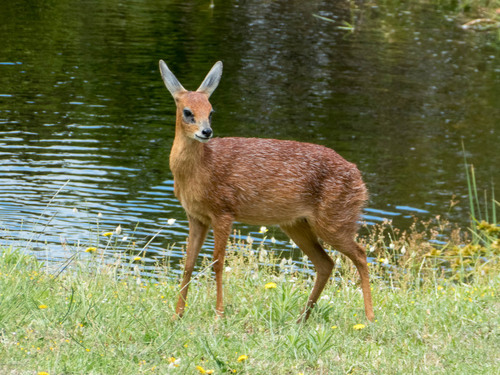
Cape Grysbok
Raphicerus melanotis
The Cape Grysbok is the Western Cape's most elusive garden visitor, a tiny, grizzled antelope that thrives in the secret corners of the fynbos.
Quick Identification
Size
Standing 45–55 cm (18–22 in) at the shoulder and weighing between 8–12 kg (18–26 lbs).
Colors
Rich reddish-brown coat interspersed with white hairs giving a 'grizzled' appearance; pale underparts and white 'spectacles' around the eyes.
Key Features
- Grizzled reddish coat flecked with white
- Large, rounded ears with dark inner margins
- Short, straight black horns (6-8cm) found only on males
- Distinctive hunched posture while running
When You’ll See Them
Geographic range
Where Does the Cape Grysbok Live?
Native exclusively to the African continent, the Cape Grysbok is a South African endemic with a highly localized range. It is found only within the Western Cape province and parts of the Eastern Cape, spanning the region from the Cederberg Mountains in the north down to the Cape Peninsula and eastward toward the Albany district near Port Elizabeth. It is a specialist of the Cape Floristic Region and is not found naturally anywhere else in the world.
Basemap © OpenStreetMap contributors
Behavior
The Cape Grysbok is a notoriously shy and solitary antelope, spending the heat of the day tucked away in thick coastal scrub or fynbos vegetation. They are primarily nocturnal or crepuscular, emerging from cover at dusk to forage. Unlike many other antelope species, they do not form herds; individuals are highly territorial and use dung middens (latrines) to mark their home range. They are known for their 'skulking' behavior, moving low to the ground and freezing or diving into dense cover if they sense a threat.
In areas where suburban gardens or vineyards border natural vegetation, they have become surprisingly well-adapted to human presence, though they remain elusive. They rarely need to drink standing water, obtaining most of their hydration from the succulent plants and dew-covered leaves they consume. When alarmed, they move with a characteristic scuttling run, keeping their heads down rather than leaping like a Springbok.
EverydayEarth exclusive
Camera Tips
To capture the Cape Grysbok, camera placement is everything. Because they are quite short—standing only about 50cm at the shoulder—you must mount your camera much lower than you would for a deer or larger antelope. Aim for a height of 30–40 cm (12–15 inches) off the ground, angled slightly upward. This ensures you capture their facial markings and the 'grizzled' texture of their coat rather than just a view of their back.
Look for 'game trails' or small tunnels through thick brush. Cape Grysbok are creatures of habit and will use the same paths night after night to move from their sleeping spots to foraging areas. Positioning your camera near the edge of a garden or vineyard where it meets natural scrub is a high-probability strategy. They are especially fond of the succulent new growth found in well-watered gardens during the dry summer months.
Since they are primarily nocturnal, ensure your camera has a high-quality infrared flash that won't spook them. Avoid using white light flashes, which may cause them to avoid the area in the future. Because they move slowly while browsing, a standard trigger speed is usually sufficient, but setting the camera to take a 10-second video clip is often more rewarding than a still photo, as it allows you to observe their cautious, twitchy movements and large, scanning ears.
Similar Species
Species that look similar or are commonly confused with Cape Grysbok.
Frequently Asked Questions
Record Cape Grysbok at your habitat
Connect a camera to start building your own species record — AI identifies every visitor automatically.