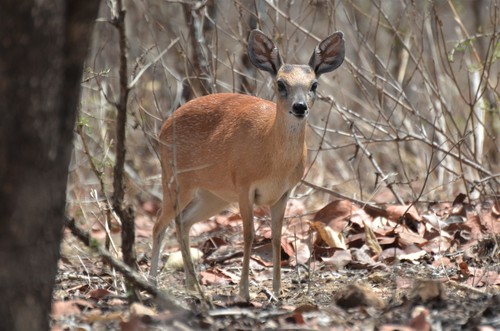
Sharpe's Grysbok
Raphicerus sharpei
The Sharpe's Grysbok is a tiny, grizzled ghost of the African bush. This solitary, nocturnal browser uses its salt-and-pepper coat to vanish into the shadows of rocky thickets.
Quick Identification
Size
Standing 45–55 cm (18–22 in) at the shoulder; weighing between 7–11 kg (15–24 lbs).
Colors
Rich reddish-brown coat with distinct white 'grizzling' caused by interspersed white hairs. The underparts, throat, and eye-rings are a pale cream or off-white. Males possess short, spike-like black horns, while females are hornless.
Key Features
- Reddish coat heavily flecked with white hairs
- Large, rounded ears with white interiors
- Small, stubby tail
- Lacks 'false hooves' on the back of the legs
- Hunched, low-slung posture when walking
When You’ll See Them
Behavior
Sharpe's Grysbok is a master of the 'hunker down' strategy. This incredibly shy and solitary antelope spends the vast majority of its daylight hours hidden in the deepest recesses of thickets, rocky crevices, or even abandoned aardvark burrows. Unlike larger plains game that flee at the first sign of danger, the grysbok remains perfectly motionless, relying on its grizzled camouflage to blend into the leaf litter. It will only bolt at the very last second, staying low to the ground as it zigs and zags through dense cover.
While they are primarily solitary, they are highly territorial. Both males and females use large pre-orbital glands (located just in front of their eyes) to deposit a black, tar-like scent on twigs and grass stalks to mark their boundaries. Because of their secretive nature and preference for thick cover, they are rarely seen by humans, making them a 'trophy' species for backyard camera trappers in Southern Africa.
EverydayEarth exclusive
Camera Tips
To capture the Sharpe's Grysbok, you must think small and low. These antelope rarely stand taller than 20 inches, so mounting your camera at knee-height (about 12-18 inches from the ground) is essential. If you mount it too high, you’ll likely only catch the top of their backs or miss them entirely as they move through the grass. Aim your camera at small 'tunnels' or openings in dense brush, as these are the highways they use to navigate their territory safely.
Because they are strictly nocturnal and very skittish, a 'No-Glow' or high-end 'Black IR' flash is mandatory. Standard infrared LEDs that emit a faint red glow will often spook a grysbok, causing it to bolt and potentially avoid that specific path for days. Use a fast trigger speed—ideally under 0.3 seconds—because when they move, they tend to trot quickly between patches of cover.
Water is your best friend for attracting this species. In drier months, a low-profile ground-level water basin or a leaky irrigation pipe will draw them in regularly. Place the camera facing the water source from a distance of 6-8 feet to ensure the flash doesn't overexpose their white-flecked coat, which can be quite reflective at night. Set your camera to 15-second video clips to observe their fascinating scent-marking behavior, where they press their face against twigs to mark their territory.
Similar Species
Species that look similar or are commonly confused with Sharpe's Grysbok.
Frequently Asked Questions
Record Sharpe's Grysbok at your habitat
Connect a camera to start building your own species record — AI identifies every visitor automatically.