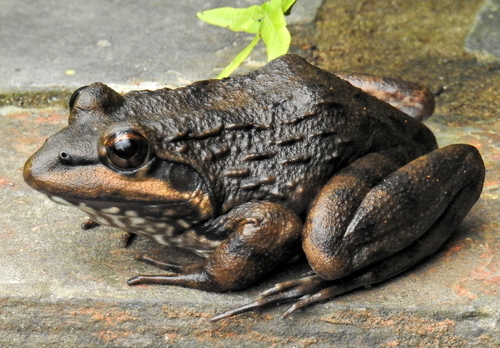
Cape River Frog
Amietia fuscigula
Meet the Cape River Frog, the powerful jumper of South Africa's waterways. Known for its distinctive 'clucking' call and beautiful marbled throat, this resilient amphibian is a frequent guest in backyard ponds across the Cape.
Quick Identification
Size
75-125 mm (3-5 inches) in length; 50-150g (1.8-5.3 oz) in weight
Colors
Variable olive-green to dark brown upperparts with dark, irregular blotches; creamy-white underparts; often features a thin pale green or yellow stripe down the spine
Key Features
- Large, powerful muscular hind legs with extensively webbed feet
- Pointed snout with prominent eyes
- Dark marbling or mottling on the throat
- Often has a thin, light-colored vertebral stripe
When You’ll See Them
Geographic range
Where Does the Cape River Frog Live?
This robust amphibian is native to the southern tip of the African continent, primarily concentrated in the fynbos and succulent karoo biomes of South Africa. Its core range spans the Western Cape and Eastern Cape provinces, extending into parts of the Northern Cape and Lesotho. Because it depends on permanent water for survival and breeding, it is frequently found in both high-altitude mountain catchments and lowland river systems throughout these regions.
Basemap © OpenStreetMap contributors
Behavior
Cape River Frogs are highly aquatic and are rarely found far from permanent water sources. They are famous for their explosive jumping ability, often leaping into the water at the slightest sign of danger with a distinct, heavy "plop." While they are active during the day—frequently seen basking on riverbanks or floating at the surface—they are most vocal and active during the night hours.
During the breeding season, males produce a series of deep, percussive clicks or "clucks" that can sound like a slow-dripping tap or two stones being knocked together. They are relatively bold compared to other frogs and can become quite accustomed to human presence in garden ponds, provided there is enough vegetation for cover and they don't feel directly threatened.
EverydayEarth exclusive
Camera Tips
To capture the Cape River Frog on camera, focus your efforts on the "splash zone." Place your camera on a small tripod or mount just 10-20 cm (4-8 inches) above the water level, aimed at a flat rock or a muddy bank where frogs are likely to bask in the sun. Because they are sensitive to movement, a camera with a fast trigger speed is essential to catch them before they leap into the water.
Use a wide-angle lens setting if available, as these frogs often sit quite close to the lens when positioned at the water's edge. If your camera has a "time-lapse" mode, this can be particularly effective during the day to capture basking behavior without needing to trigger the PIR sensor, which can sometimes struggle with cold-blooded animals. For night shots, ensure your infrared flash is not too bright, as it can wash out the frog's shiny, wet skin; a piece of semi-transparent tape over the flash can help diffuse the light and preserve the detail of their markings.
Positioning your camera near aquatic vegetation like reeds or water lilies increases your chances, as these provide the cover the frogs prefer. If you have a garden pond, aim the camera at the shallow "beach" area or a flat lily pad. Since they are attracted to movement, a small solar-powered water dripper can sometimes entice them to a specific spot, as the ripples and sound mimic the insects they hunt.
Similar Species
Species that look similar or are commonly confused with Cape River Frog.
Frequently Asked Questions
Record Cape River Frog at your habitat
Connect a camera to start building your own species record — AI identifies every visitor automatically.