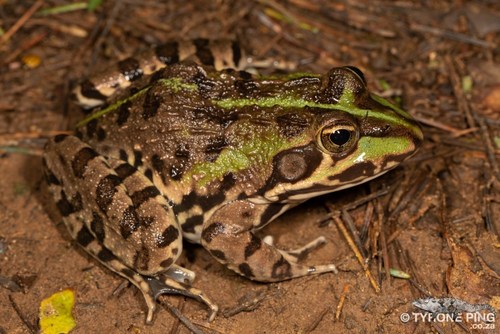
Poynton's River Frog
Amietia poyntoni
A sleek and athletic resident of South Africa's misty highlands, Poynton's River Frog is a master of the mountain stream. Recognizable by its striking racing stripe and incredible jumping ability, it is a favorite for backyard pond enthusiasts in the KwaZulu-Natal midlands.
Quick Identification
Size
Small to medium-sized, typically 35-55 mm (1.4-2.2 inches) from snout to vent
Colors
Olive-green to bronze-brown with irregular dark blotches; most individuals feature a thin, pale green or yellow line running down the center of the back
Key Features
- Distinct pale vertebral stripe running from snout to vent
- Long, powerful hind legs with extensive webbing
- Pointed snout and large, prominent eardrums (tympana)
- Skin is generally smooth with small glandular ridges on the back
When You’ll See Them
Geographic range
Where Does the Poynton's River Frog Live?
Poynton’s River Frog is native to the African continent and is endemic to the southeastern regions of South Africa. It is primarily found within the cool, moist highlands of the KwaZulu-Natal midlands and the foothills of the Drakensberg mountains. This species is a true specialist of the mist-belt region, restricted to areas with high rainfall and consistent freshwater access, and is not found in the drier western or coastal lowland parts of the country.
Basemap © OpenStreetMap contributors
Behavior
Poynton's River Frog is a highly aquatic species that spends most of its life at the edge of permanent water sources. During the day, they are often found basking on rocks or hidden among thick riparian vegetation. If disturbed, they utilize their exceptionally long hind legs to perform a series of powerful, zigzagging leaps toward the safety of the water, where they can remain submerged for long periods.
These frogs are primarily nocturnal, particularly when it comes to social interaction and breeding. During the rainy season, males establish calling territories along stream banks. Their call is a relatively quiet, percussive clicking sound, which can be difficult to hear over the rush of moving water but is a clear signal to females in the area. They are generally solitary except when congregating for breeding in suitable wetland habitats.
EverydayEarth exclusive
Camera Tips
To capture Poynton’s River Frog on your backyard camera, you must focus on the water-land interface. Position your camera on a small tripod or mount it very low to the ground, roughly 6 inches high, pointing at a flat rock or a clear patch of bank where a frog might sit to hunt. Because they are small, a camera with a short focal distance or a dedicated macro mode will provide the clearest images.
Lighting is your biggest challenge since these frogs are most active after dark. Use a camera with high-quality infrared (IR) LEDs to avoid spooking the frog with a bright white flash, which might cause them to jump into the water before the shutter fires. If your camera has a 'fast trigger' setting, enable it; river frogs are notoriously skittish and will vanish in a fraction of a second if they sense movement.
The best time to set your camera is immediately following a heavy afternoon thunderstorm in the summer. The humidity and fresh rainwater trigger high activity and calling behavior. If you have a garden pond, placing the camera near 'shelf' areas with shallow water and emergent plants will increase your chances of capturing them as they emerge from the water to forage for insects.
Similar Species
Species that look similar or are commonly confused with Poynton's River Frog.
Frequently Asked Questions
Record Poynton's River Frog at your habitat
Connect a camera to start building your own species record — AI identifies every visitor automatically.