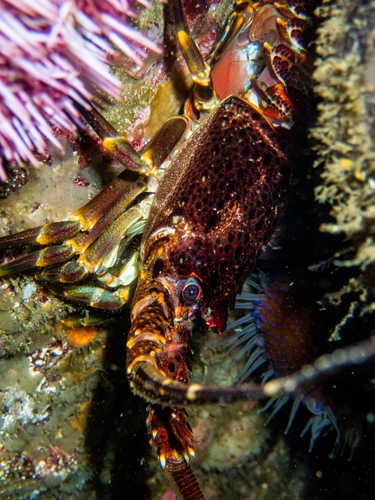
Cape Rock Lobster
Jasus lalandii
The spiny sentinel of the Atlantic kelp forests, the Cape Rock Lobster is a master of the rocky reef. With its brilliant orange-red armor and lightning-fast reflexes, it is an iconic resident of the Southern African coast.
Quick Identification
Size
Carapace length up to 16 cm (6.3 in); total body length up to 46 cm (18 in); weighs between 0.5 and 2 kg (1.1–4.4 lbs).
Colors
Vibrant reddish-brown to burnt orange carapace; legs are typically orange-yellow with darker joints; underside is creamy white to pale orange.
Key Features
- Robust carapace covered in forward-pointing spines
- Long, thick spiny antennae that exceed body length
- Complete absence of large front crushing claws (pincers)
- Five pairs of walking legs with pointed tips
When You’ll See Them
Geographic range
Where Does the Cape Rock Lobster Live?
Where Does the Cape Rock Lobster Live? This species is a native specialist of the Southern African coastline, thriving in the nutrient-rich, cold waters of the Atlantic Ocean. Its core range spans from the northern waters of Namibia near Walvis Bay, southward along the entire West Coast of South Africa, and around the Cape of Good Hope. While its highest populations are found in the Benguela Upwelling System, it can be spotted as far east as East London, though it becomes less common as the water warms toward the Indian Ocean.
Basemap © OpenStreetMap contributors
Behavior
The Cape Rock Lobster is a highly social but competitive crustacean that defines the rocky sub-tidal ecosystems of Southern Africa. During the day, they are relatively sedentary, congregating in large numbers within 'lobster hotels'—deep rock crevices and underwater caves—to protect themselves from predators like octopuses, Cape fur seals, and various shark species. They are famously known for their 'caridoid escape reaction,' where they rapidly flex their muscular tails to swim backward at high speeds to evade capture.
As nocturnal foragers, they emerge from their shelters at sunset to roam the reef and kelp forests. While they are generally peaceful toward one another in the wild, they can become quite territorial over prime crevice real estate. Their social structure is loose, but they are often found in high-density clusters, which helps confuse predators. Interactions with humans occur primarily through the fishing industry and scuba diving, where they are known to be curious but cautious of divers.
EverydayEarth exclusive
Camera Tips
To capture high-quality footage of the Cape Rock Lobster, you will need an underwater camera setup, such as an action camera in a specialized dive housing. Because these lobsters are most active at night and live in dark crevices, external lighting is essential. Use an LED video light with a wide beam angle to illuminate the reef without creating 'hot spots' on the lobster's reflective carapace. Positioning the light slightly to the side of the camera will help reduce backscatter from particles in the water.
For the best shots, identify a 'lobster hole' during the day—look for their long, whip-like antennae poking out from under rocky ledges or within kelp holdfasts. Secure your camera to a heavy diving weight or a tripod ballasted with rocks to keep it steady against the surge and current. Angle the lens slightly upward toward the crevice opening to capture the lobster as it emerges for its nightly forage. AI-powered movement triggers are particularly useful here, as they can save battery life by only recording when the lobster’s antennae or body move into the frame.
Using a 'bait station' is an effective way to bring the Cape Rock Lobster into a clear field of view. Place a mesh bag filled with crushed mussels or oily fish approximately 30-50 cm in front of the lens. The scent will draw them out from their hiding spots, allowing you to observe their intricate feeding behaviors and the way they use their smaller mouthparts. Be mindful of the tide; low-surge conditions during a high tide usually provide the best water clarity for backyard underwater photography.
Similar Species
Species that look similar or are commonly confused with Cape Rock Lobster.
Frequently Asked Questions
Record Cape Rock Lobster at your habitat
Connect a camera to start building your own species record — AI identifies every visitor automatically.