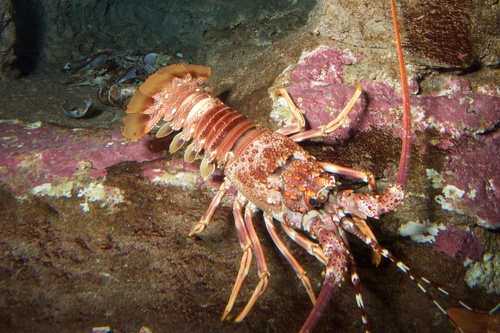
East Coast Rock Lobster
Panulirus homarus
A master of the surf zone, the East Coast Rock Lobster is a vibrant, spiny inhabitant of Indo-Pacific rocky reefs. Watch them emerge from their secret caverns at night to hunt among the waves.
Quick Identification
Size
20–25 cm (7.9–9.8 in) in length; typically weighs between 0.5–1.2 kg (1.1–2.6 lbs)
Colors
Dark green to brownish-black body with prominent white spots on the abdomen; legs are often striped or marbled with lighter shades; some regional subspecies appear reddish-orange.
Key Features
- Two pairs of long, thick antennae used for defense and sensing
- Spiny, armored carapace without large front claws
- Distinctive white spotting along the sides of the tail segments
- Small blue or green iridescent patches near the base of the antennae
When You’ll See Them
Geographic range
Where Does the East Coast Rock Lobster Live?
Native to the vast Indo-Pacific region, the East Coast Rock Lobster thrives along the diverse coastlines of the Indian and Pacific Oceans. Its primary range extends from the southern tip of Africa and Mozambique, stretching northward along the East African coast to the Arabian Peninsula and India. It is also commonly found throughout Southeast Asia, including Indonesia and Thailand, reaching as far east as the tropical waters of Northern Australia and the Southwest Pacific islands.
Basemap © OpenStreetMap contributors
Behavior
The East Coast Rock Lobster is a reclusive, nocturnal crustacean that spends the daylight hours tucked deep within the protection of rocky crevices and coral reef overhangs. Unlike many of its deep-sea relatives, this species prefers the high-energy environment of the surf zone, where oxygen levels are high and the turbulent water provides cover from predators. They are social creatures to an extent, often sharing a single large crevice with several other lobsters, though they will aggressively defend their personal space if food is scarce.
When night falls, these lobsters emerge to forage across the seafloor. They move with a deliberate, walking gait using their four pairs of legs, but they possess a remarkable 'escape' reflex. By rapidly snapping their powerful muscular tails, they can propel themselves backward at high speeds to avoid octopuses, sharks, and human divers. While they are generally shy around humans, they are known to be curious about underwater lights and stationary objects in their environment.
EverydayEarth exclusive
Camera Tips
Capturing the East Coast Rock Lobster on camera requires an underwater approach, typically using a waterproof action camera or a specialized marine trail cam rig. Because these lobsters inhabit the 'surge zone' where waves break against rocks, your camera housing must be heavily weighted or securely bolted to a stable rock structure to prevent it from being tossed by the tide. Aim your lens at the mouth of dark crevices or under rocky ledges during the late afternoon to catch them as they first emerge for the evening.
Since they are strictly nocturnal, artificial lighting is mandatory. However, lobsters are sensitive to bright white light and may retreat if a strobe is too intense. Use a camera equipped with infrared (IR) or a very low-intensity red LED light. Red light is less visible to many marine invertebrates and will allow you to capture natural foraging behavior without startling the subject. Set your camera to record short video clips (15-30 seconds) rather than still photos to capture their interesting walking movements and antennal waving.
To guarantee a sighting, use a scent-based lure. A mesh 'bait bag' filled with crushed mussels or oily fish like sardines is irresistible to them. Secure the bait bag roughly 12 to 18 inches in front of the lens. The lobster will often spend a significant amount of time trying to pick through the mesh, providing you with excellent close-up footage of their mouthparts and front legs in action. Make sure to check the tide tables and set your gear during low tide to ensure safety and ease of access.
Similar Species
Species that look similar or are commonly confused with East Coast Rock Lobster.
Ornate Spiny Lobster
Much larger with colorful, leopard-like patterns on its legs and large dark spots on its carapace.
Cape Rock Lobster
Lacks the white spots on the tail and has a much rougher, more 'bumpy' texture on its shell.
Longlegged Spiny Lobster
Has much longer, more slender legs and prefers deeper, calmer coral reef environments.
Frequently Asked Questions
Record East Coast Rock Lobster at your habitat
Connect a camera to start building your own species record — AI identifies every visitor automatically.