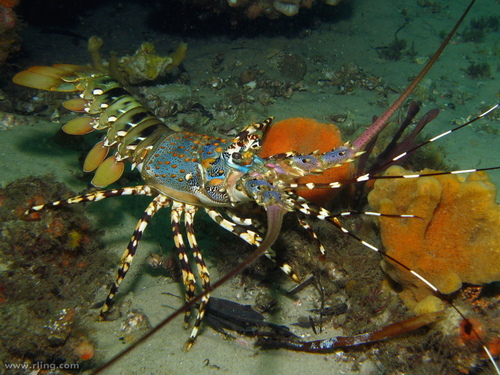
Ornate Spiny Lobster
Panulirus ornatus
The Ornate Spiny Lobster is the crown jewel of the tropical reef, showcasing a brilliant tapestry of turquoise, gold, and emerald. Famous for its epic undersea migrations and striking striped legs, it is one of the most beautiful invertebrates in the ocean.
Quick Identification
Size
Length up to 50 cm (20 in); weight typically ranges from 1 to 2 kg (2.2–4.4 lbs)
Colors
Elaborate turquoise and green carapace with yellow and black highlights; legs are distinctly striped in cream and black; abdominal segments feature paired white and black spots
Key Features
- Vibrant, multi-colored carapace with turquoise and emerald hues
- Striking cream and black horizontal stripes on walking legs
- Absence of large front claws, replaced by long, thick, spiny antennae
- Unique double-spot pattern on the sides of each tail segment
When You’ll See Them
Geographic range
Where Does the Ornate Spiny Lobster Live?
The Ornate Spiny Lobster is native to the warm, tropical waters of the Indo-West Pacific. Its vast range begins along the eastern coast of Africa and the Red Sea, stretching across the Indian Ocean to the shores of Southeast Asia and northern Australia. These lobsters are particularly abundant in the Coral Triangle and are frequently found around the island nations of the South Pacific, including Fiji and the Solomon Islands, with occasional sightings as far north as southern Japan.
Basemap © OpenStreetMap contributors
Behavior
The Ornate Spiny Lobster is a primarily nocturnal crustacean that spends its daylight hours seeking refuge in the deep crevices of coral reefs or beneath rocky ledges. Unlike the American lobster, this species lacks large crushing claws; instead, it relies on its heavily armored, spiny body and powerful antennae to fend off predators like octopuses and large reef fish. They are remarkably sensitive to movement and chemical changes in the water, using their long antennae to scan their surroundings for danger while remaining tucked away.
One of the most fascinating aspects of their behavior is their seasonal mass migration. In regions like the Torres Strait, these lobsters engage in a coordinated 'march' across the seafloor, forming long single-file lines to move into deeper water for spawning. During the night, they emerge from their shelters to become active hunters and scavengers, covering significant distances across sandy or muddy bottoms to find food before retreating to the safety of the reef at dawn.
EverydayEarth exclusive
Camera Tips
To successfully capture the Ornate Spiny Lobster on a trail camera, you will need a waterproof housing rated for marine environments and a stable mounting system. Position your camera near 'lobster hotels'—the specific holes or ledges in a reef where antennae are visible during the day. Use a weighted base or a heavy-duty suction mount to ensure the camera stays still against tidal currents and surge.
Lighting is the most critical element for nocturnal marine photography. Use a red-light filter or infrared LEDs if your camera supports it, as bright white lights can startle the lobster and cause it to 'tail-flip' away instantly. If you must use white light, position your external flashes at a 45-degree angle to the lens. This technique, known as off-camera lighting, prevents backscatter—the annoying white spots caused by light reflecting off plankton and sediment in the water.
For the best results, use a perforated bait container filled with crushed oily fish or mollusks and stake it approximately one meter in front of the lens. Set your camera to video mode rather than still photos; the slow, methodical way these lobsters use their legs and antennae to investigate the bait is far more captivating in motion. If you are deploying the camera in an area known for migrations, aim the lens across a sandy clearing adjacent to a reef during the late lunar cycles of spring and autumn.
Similar Species
Species that look similar or are commonly confused with Ornate Spiny Lobster.
Frequently Asked Questions
Record Ornate Spiny Lobster at your habitat
Connect a camera to start building your own species record — AI identifies every visitor automatically.