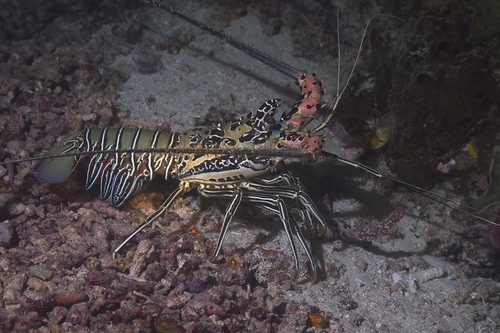
Painted Spiny Lobster
Panulirus versicolor
A masterpiece of marine evolution, the Painted Spiny Lobster sports a psychedelic coat of blue, green, and striped patterns. This nocturnal reef dweller is one of the most beautiful and elusive scavengers of the Indo-Pacific coral gardens.
Quick Identification
Size
Typically 25–30 cm (10–12 inches) in length, though large adults can reach up to 40 cm (16 inches) excluding antennae.
Colors
Deep blue-green or turquoise body; legs are boldly striped with black and white; antennae bases are pinkish-orange; abdominal segments feature transverse white bands.
Key Features
- Extraordinarily long, white, whip-like antennae
- Distinctive black and white longitudinal stripes on all walking legs
- Dark green or blue carapace with white-bordered black spots
- Lack of large front claws (pincers) common in other lobsters
When You’ll See Them
Geographic range
Where Does the Painted Spiny Lobster Live?
This species is native to the vast tropical waters of the Indo-Pacific region, spanning a massive geographic area from the Red Sea and the eastern coast of Africa to the islands of French Polynesia. Its core range includes the coral-rich waters of northern Australia, Southeast Asia, and the Philippine archipelago, extending as far north as southern Japan. While they are a resident species across this entire belt, they are particularly common in the diverse reef systems surrounding Sri Lanka and Indonesia.
Basemap © OpenStreetMap contributors
Behavior
The Painted Spiny Lobster is a primarily nocturnal inhabitant of the reef, spending its daylight hours tucked deep within the protection of coral crevices, ledges, and underwater caverns. Unlike the more social Caribbean spiny lobsters, this species is typically solitary or found in mating pairs. They are highly territorial regarding their chosen crevice and will use their long antennae to fend off intruders or detect approaching predators from a distance.
When night falls, they emerge to roam the reef floor and sandy lagoon patches in search of food. They are surprisingly agile, using their powerful muscular tails to propel themselves backward in a sudden burst if they feel threatened—a behavior known as the caridoid escape reaction. While they are not aggressive toward humans, they are shy and will quickly retreat into the reef at the first sign of bright light or heavy vibration.
EverydayEarth exclusive
Camera Tips
Capturing the Painted Spiny Lobster requires a specialized waterproof camera setup, as these animals are strictly aquatic. If your 'backyard' is a coastal reef, look for the tell-tale sign of long, white antennae protruding from a coral head during the day. This indicates a 'den.' Mount your camera on a weighted base or a heavy dive tripod nearby, angling the lens toward the crevice opening. Position the camera about 2-3 feet away to ensure the lobster’s massive antennae don't whip against the lens and cause motion blur or focus issues.
Because they are strictly nocturnal, high-quality infrared (IR) or red-light illumination is essential. Traditional white lights often cause these lobsters to retreat immediately back into their holes. Red light is less visible to marine invertebrates and will allow you to capture their natural emerging behavior. Set your camera to a motion-trigger mode with a high sensitivity, as their movements can be subtle when they first emerge. A wide-angle lens is best to capture both the lobster and its environment.
To increase your chances of a close-up, you can use a scent-based lure. A mesh bag containing crushed mollusks or oily fish scraps placed directly in front of the camera's field of view can keep the lobster occupied for several minutes, providing excellent footage. Be sure to secure the lure tightly, or a passing eel or ray might swim off with it. For the most active footage, try filming during the nights around a new moon, when the lack of ambient moonlight encourages reef scavengers to forage more boldly.
Similar Species
Species that look similar or are commonly confused with Painted Spiny Lobster.
Ornate Spiny Lobster
Features spotted legs rather than striped ones and grows significantly larger, often with a more varied, multicolored carapace.
Longlegged Spiny Lobster
Has a darker, reddish-brown body covered in numerous small white spots, lacking the bold stripes and blue-green base of the Painted Spiny Lobster.
Frequently Asked Questions
Record Painted Spiny Lobster at your habitat
Connect a camera to start building your own species record — AI identifies every visitor automatically.