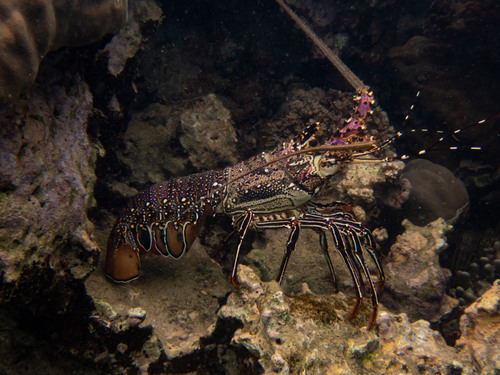
longlegged spiny lobster
Panulirus longipes
A nocturnal wonder of the Indo-Pacific, the longlegged spiny lobster is easily identified by its spindly limbs and star-dusted armor. This reclusive reef-dweller turns the nighttime seafloor into a theater of alien-like movement and vibrant color.
Quick Identification
Size
Body length typically 20-25 cm (8-10 in), with a maximum of 30 cm (12 in); weights range from 0.5-1 kg (1.1-2.2 lbs).
Colors
Dark reddish-brown to deep indigo body covered in numerous small, circular white spots; legs are similarly spotted or striped depending on the subspecies.
Key Features
- Two large, forward-pointing 'horns' over the eyes
- Extremely long and slender walking legs
- Carapace and abdomen densely covered in small white spots
- No large pincer claws, typical of spiny lobsters
- Pair of very long, thick, spiny antennae
When You’ll See Them
Geographic range
Where Does the longlegged spiny lobster Live?
Where Does the Longlegged Spiny Lobster Live? This vibrant marine species is native to the warm, tropical waters of the Indo-Pacific region. Its territory stretches from the eastern coast of Africa and the Red Sea across the Indian Ocean to the central Pacific islands. It is particularly abundant in the coral-rich archipelagos of Indonesia and the Philippines, and its range extends as far north as southern Japan and as far south as the northern coast of Australia and the islands of Oceania.
Basemap © OpenStreetMap contributors
Behavior
When darkness falls, they emerge to navigate the reef flat using their sensitive antennae to detect chemical cues from food. They are remarkably agile, capable of walking rapidly over complex terrain on their elongated legs. If startled, they employ a 'caridoid escape reaction'—a powerful snap of the tail that propels them backward at high speed to avoid threats like octopuses or reef sharks. They are also known to produce a loud, rasping stridulatory sound by rubbing their antennae against a specialized plate near their eyes, likely to startle attackers.
EverydayEarth exclusive
Camera Tips
Capturing the longlegged spiny lobster requires specialized underwater equipment, as they rarely venture into the extremely shallow intertidal zones where standard trail cams might work. Use a dedicated underwater trail camera or a high-end action camera with a dive housing rated for at least 15 meters. Because these lobsters are strictly nocturnal, your camera must have a 'no-glow' infrared flash. White light flashes often cause marine life to retreat and create significant 'backscatter'—where the light reflects off plankton and sand—obscuring your subject. Infrared allows you to see the intricate white spotting on their carapace without disturbing their natural foraging behavior.
The best placement for your camera is near the base of a coral head or a rocky ledge where you've spotted antennae protruding during the day. Mount the camera on a weighted tripod or a sand-screw mount about 2 to 3 feet away from the crevice entrance. Position the lens at a low angle, slightly upward, to capture the lobster's full profile and its exceptionally long legs as it emerges. If you are in a high-current area, ensure the camera is heavily weighted or tethered to a stable rock to prevent it from vibrating or being swept away.
To guarantee a sighting, use a scent-based attractant. A small mesh 'chum bag' filled with crushed mollusks, shrimp shells, or oily fish scraps tied approximately 18 inches in front of the lens will almost certainly draw a lobster out of its den. Set your camera to record 20-second video clips rather than stills; the way these lobsters use their antennae to 'taste' the water and their delicate, spider-like walking movements are best appreciated in motion. Aim for a new moon cycle to deploy your camera, as these lobsters are most active when ambient light is at its lowest, reducing their visibility to predators.
Similar Species
Species that look similar or are commonly confused with longlegged spiny lobster.
Frequently Asked Questions
Record longlegged spiny lobster at your habitat
Connect a camera to start building your own species record — AI identifies every visitor automatically.