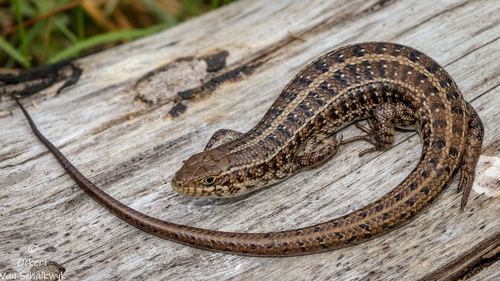
Cape Skink
Trachylepis capensis
The Cape Skink is the quintessential backyard lizard of southern Africa. With its glossy striped back and surprisingly bold personality, it is a favorite subject for wildlife photographers and garden enthusiasts alike.
Quick Identification
Size
20–30 cm (8–12 inches) in total length; weight typically 30–60g
Colors
Olive-brown to grey-brown body with three prominent pale-yellow or cream longitudinal stripes; underside is uniform white or pale yellow
Key Features
- Three distinct pale stripes running from the head to the tail
- Short, sturdy limbs with five toes on each foot
- Smooth, glossy scales that overlap tightly
- Heavy-bodied appearance with a broad, rounded snout
When You’ll See Them
Geographic range
Where Does the Cape Skink Live?
The Cape Skink is a hallmark species of southern Africa, natively thriving across a vast expanse of the subcontinent. Its core population is centered in South Africa, but it is also commonly found throughout Namibia, Botswana, Zimbabwe, and Mozambique. Because of its high adaptability, it has successfully occupied almost every ecological niche within these countries, from coastal dunes to high-altitude inland plateaus.
Basemap © OpenStreetMap contributors
Behavior
These skinks are primarily solitary but are not overly territorial, often congregating in areas with abundant food and prime basking real estate. Interestingly, they are viviparous, meaning the female gives birth to between 5 and 18 fully formed live young rather than laying eggs. This reproductive strategy helps protect the offspring from the many predators that target reptile eggs in the African bush.
EverydayEarth exclusive
Camera Tips
Since reptiles don't always trigger standard PIR sensors as reliably as warm-blooded mammals, consider using a 'Time Lapse' or 'Time-of-Day' setting. Set the camera to take a photo every 60 seconds between 10:00 AM and 2:00 PM. This is the window when the sun is highest and the skinks are most likely to be stationary while basking, providing perfectly focused, clear images for identification.
While they are naturally curious, you can encourage them to linger in front of your camera by providing a shallow water dish or creating a 'rock pile' nearby to offer them a sense of security. Avoid placing the camera in deep shade; these lizards follow the sun, so your camera should be positioned in an area that receives at least 4-6 hours of direct sunlight. Ensure the foreground is clear of tall grass or waving weeds that might cause false triggers on windy days.
Similar Species
Species that look similar or are commonly confused with Cape Skink.
Frequently Asked Questions
Record Cape Skink at your habitat
Connect a camera to start building your own species record — AI identifies every visitor automatically.