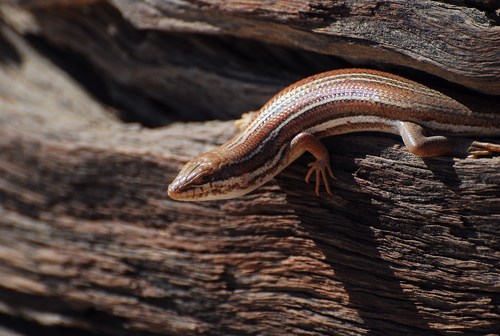
Western three-striped skink
Trachylepis occidentalis
A striking, fast-moving gem of the African arid-lands, the Western three-striped skink is a master of the 'sun-and-run' lifestyle. With its glossy scales and racing stripes, it brings a flash of elegance to any sun-drenched garden or rocky outcrop.
Quick Identification
Size
18–25 cm (7–10 inches) in total length; Snout-vent length (SVL) approximately 7–9 cm (2.7–3.5 inches).
Colors
Glossy dark brown or blackish body with three distinct cream to pale yellow longitudinal stripes; creamy white or light gray belly.
Key Features
- Three prominent pale stripes running from the head to the tail
- Smooth, highly reflective scales with an iridescent sheen
- Slender body with a long, fragile tail
- Five-toed limbs with small, sharp claws for navigating rocks.
When You’ll See Them
Geographic range
Where Does the Western three-striped skink Live?
The Western three-striped skink is a specialist of the arid regions of Southern Africa. Its core population thrives across the western half of South Africa, extending north through the vast deserts and scrublands of Namibia. It is also commonly found in the dry savanna regions of Botswana and reaches its northernmost limits in the arid southern provinces of Angola.
Basemap © OpenStreetMap contributors
Behavior
The Western three-striped skink is an incredibly agile and alert reptile, characterized by its "sun-and-run" lifestyle. As a diurnal species, its day revolves around thermoregulation. You will often find it basking on flat rocks or garden walls in the early morning to reach its optimal operating temperature. Once warm, it becomes a lightning-fast predator, darting through leaf litter with a fluid, snake-like motion to ambush insects.
These skinks are generally solitary and wary of large movements, though they can become quite accustomed to human presence in quiet suburban gardens. They are terrestrial but are capable climbers when pursuing prey or escaping a predator. Like many skinks, they possess the ability to drop their tails if grabbed, a defensive mechanism known as autotomy, which allows the lizard to escape while the predator is distracted by the wiggling tail.
EverydayEarth exclusive
Camera Tips
Capturing the Western three-striped skink on camera requires a focus on their favorite basking spots. Look for flat, light-colored stones or the tops of brick garden walls that receive direct morning sunlight. Mount your camera low to the ground—ideally just 5 to 10 inches high—and angle it slightly downward. Because these lizards are remarkably fast, set your AI camera to its highest trigger sensitivity and use a short burst mode to ensure you catch more than just a disappearing tail.
In backyard settings, these skinks are attracted to "micro-habitats." You can lure them into the camera's field of view by placing a very shallow water dish or a flat piece of slate near a woodpile or rockery. The skink will visit these spots daily once it identifies them as safe. Ensure the area is clear of tall grass that might trigger the camera on windy days, as you want to save your battery for the lizard's movement.
The best time for high-quality footage is mid-morning (between 9 AM and 11 AM) when the light is bright but the lizards are still moving slowly enough to warm up. In the peak of summer, they may retreat during the hottest part of the day, so focus your monitoring on the shoulder hours of the morning and late afternoon. If your camera supports it, high-frame-rate video is excellent for capturing their rapid, darting hunting strikes.
Similar Species
Species that look similar or are commonly confused with Western three-striped skink.
Frequently Asked Questions
Record Western three-striped skink at your habitat
Connect a camera to start building your own species record — AI identifies every visitor automatically.