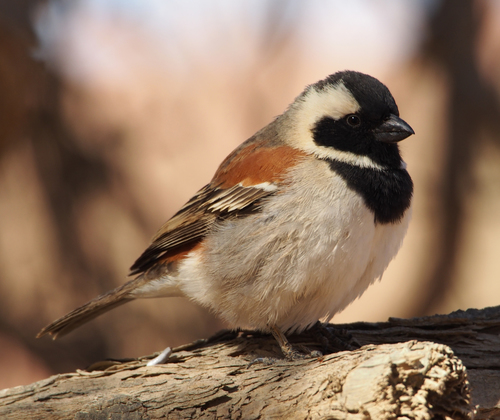
Cape Sparrow
Passer melanurus
The Cape Sparrow, affectionately known as the 'mossie,' is southern Africa's most iconic garden bird. Famous for its bold black-and-white head markings and friendly disposition, it is a master of adaptation in both wild savannas and bustling backyards.
Quick Identification
Size
14-16 cm (5.5-6.3 in) in length; weight 25-35g (0.9-1.2 oz)
Colors
Males feature a bold black head and throat with a white 'C' shape on the ear coverts and a bright chestnut back. Females are more muted with a grey-brown head and a pale buff stripe behind the eye.
Key Features
- Male has a distinctive white semicircular stripe on a black head
- Broad white wing bars visible in flight and at rest
- Bright rufous-chestnut mantle and shoulders
- Heavy, conical black bill designed for seed-crushing
When You’ll See Them
Geographic range
Where Does the Cape Sparrow Live?
Native to the southern African subcontinent, the Cape Sparrow is a widespread resident across South Africa, Namibia, Botswana, Lesotho, and Eswatini. Its range extends northwards into the southwestern corner of Angola and edges into southwestern Zimbabwe. While it is most abundant in the temperate and semi-arid regions of the south, it is successfully expanding its presence wherever human settlement provides new sources of food and water.
Basemap © OpenStreetMap contributors
Behavior
Cape Sparrows, or 'mossies' as they are known locally, are exceptionally social birds that have thrived by adapting to human-altered landscapes. They are almost always found in pairs or small, chattering flocks, spending much of their day hopping across lawns and garden paths in search of food. They are known for their bold and inquisitive nature, often becoming quite tame around houses where they may even investigate open windows or outdoor dining areas for crumbs.
These birds are highly vocal, with their repetitive 'chirp' and 'chissick' calls forming the quintessential soundtrack of southern African suburbs. Despite their small size, they are spirited defenders of their nesting sites, often chasing away larger birds. At night, they congregate in communal roosts, favoring dense, thorny trees or evergreen hedges that provide protection from predators like domestic cats or owls.
EverydayEarth exclusive
Camera Tips
To get the best shots of Cape Sparrows, position your camera at a low angle, roughly 30 to 50 centimeters (12-20 inches) above the ground. Since these are primarily ground-foraging birds, a camera placed on a tripod or mounted to a low post near a bird bath will capture their most natural behaviors. They are particularly attracted to water; a shallow basin with a textured bottom for grip will encourage them to linger and bathe, providing excellent action shots.
Baiting your camera site with a mix of small bird seeds, sunflower hearts, or crushed maize is highly effective. If you want to see their social hierarchy in action, scatter the seed in a small 1-meter radius rather than a single pile; this encourages the birds to space out and interact within the camera's field of view. Early morning light is best, as it highlights the rich chestnut plumage of the males without creating the harsh shadows often found in the midday African sun.
During the spring and summer breeding months, look for 'mossies' collecting nesting materials. If you provide a 'nesting station' with short lengths of string, pet fur, or dried grass within view of the camera, you can capture fascinating footage of them gathering supplies. Ensure your camera's trigger speed is set to its fastest setting, as these sparrows are quick, twitchy movers that can hop in and out of the frame in a split second.
Similar Species
Species that look similar or are commonly confused with Cape Sparrow.
Frequently Asked Questions
Record Cape Sparrow at your habitat
Connect a camera to start building your own species record — AI identifies every visitor automatically.