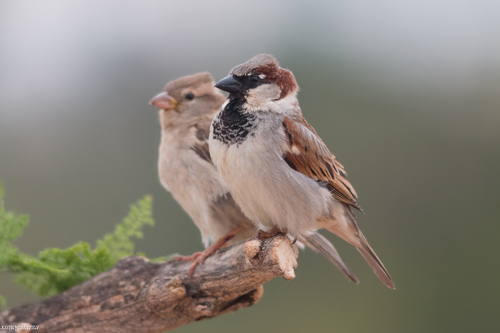
House Sparrow
Passer domesticus
The House Sparrow is the world's most successful urban bird, a social and chirpy neighbor that has lived alongside humans for millennia. Famous for their cheeky personalities and communal dust baths, they are a staple of backyard wildlife watching.
Quick Identification
Size
Length: 14–18 cm (5.5–7 in); Wingspan: 19–25 cm (7.5–10 in); Weight: 24–39.5 g (0.85–1.39 oz)
Colors
Males have a grey crown, chestnut-colored nape, and a distinctive black bib; females are sandy-brown with a pale buff eye stripe.
Key Features
- Large black bib on males (smaller in winter)
- Stout, conical bill for seed-cracking
- Greyish-white underparts
- Pale buff-colored 'eyebrow' stripe on females
When You’ll See Them
Sightings on EverydayEarth
Mar 3, 2026
Various bird species visit the feeder tray in quick succession to forage. Initially, a male House Finch and an American Tree Sparrow are present. They are later replaced by a pair of House Sparrows (male and female). The sequence ends with an American Robin landing abruptly on the rim of the tray, filling the camera's view.
May 14, 2026
A male Rose-breasted Grosbeak and a female House Sparrow are feeding together on a tray filled with sunflower seeds. The grosbeak is very active, shifting around the tray and looking directly at the camera, while the sparrow remains focused on feeding on the left side of the frame.
Feb 19, 2026
A male and female House Finch are foraging at the bird feeder tray. At approximately 0:06, a male House Sparrow lands on the wooden perch and hops into the tray to forage alongside them. The male House Finch departs around 0:09, leaving the female House Finch and the House Sparrow to continue feeding through the end of the clip.
Jul 30, 2026
A small House Sparrow is perched on the right side of the large Osprey nest structure. It stays mostly stationary, occasionally shifting its weight and looking around while the water in the background remains choppy from the wind.
Jul 25, 2026
An Osprey is perched within its large stick nest, occasionally turning its head to survey the surrounding water. On the right side of the nest, a House Sparrow is also visible, perched among the outer branches of the structure before hopping down.
Jul 25, 2026
A small House Sparrow is perched on a branch protruding from the right side of the large osprey nest. The bird remains mostly stationary while a small motorboat with one person on board travels across the water in the background from right to left.
Geographic range
Where Does the House Sparrow Live?
Originally native to the vast regions of Europe, the Mediterranean Basin, and much of Asia, the House Sparrow has become the most widely distributed wild bird on Earth. Through both intentional and accidental introductions, they have established thriving populations across North and South America, sub-Saharan Africa, Australia, and New Zealand. Where Does the House Sparrow Live? Virtually anywhere humans have built homes, these resilient birds have followed, making them a truly global neighbor found in almost every climate except the most extreme polar or rainforest environments.
Basemap © OpenStreetMap contributors
Recorded on EverydayEarth
Behavior
These birds are famous for their energetic 'dust baths,' where groups will huddle in a patch of dry soil, vigorously flapping their wings to toss dust through their feathers. They are also opportunistic and assertive at bird feeders, often being the first to arrive and the last to leave. Despite their small size, they are bold defenders of their nesting cavities, which they often stuff with grass, feathers, and scavenged human materials like string or paper.
EverydayEarth exclusive
Camera Tips
To get the best shots of House Sparrows, position your AI-powered camera near a bird feeder filled with white proso millet or sunflower hearts. Because they are ground-foragers, placing a camera on a low tripod or mounting it 1-2 feet off the ground facing a flat patio or a patch of bare earth is highly effective. This lower angle provides an intimate perspective on their social interactions and communal feeding habits.
Birdbaths are another excellent 'hotspot' for activity. House Sparrows are enthusiastic bathers and often visit in groups. A shallow water source with a textured bottom will encourage them to linger. Set your camera to video mode or high-speed burst, as their movements are quick and jerky. If you capture them mid-splash, the resulting footage is often some of the most entertaining backyard content you can get.
During the spring, look for gaps in your home's eaves or birdhouses. Mounting a camera near a known nesting site can capture the fascinating 'bib' displays of the males, who use their black throat patches to signal dominance. Because they are active from the very first light of dawn, ensure your camera has a wide aperture or good low-light performance to catch the early morning 'dawn chorus' activity when they are most vocal.
Similar Species
Species that look similar or are commonly confused with House Sparrow.
House Finch
Males have red or orange plumage on the head and breast, while female House Finches have heavy vertical streaks on their bellies which sparrows lack.
Eurasian Tree Sparrow
Distinguished by a chestnut-colored crown (rather than grey) and a prominent black spot on each white cheek.
Song Sparrow
Has a much more heavily streaked breast with a central dark spot and lacks the clean grey-and-black facial markings of the male House Sparrow.
Frequently Asked Questions
Record House Sparrow at your habitat
Connect a camera to start building your own species record — AI identifies every visitor automatically.