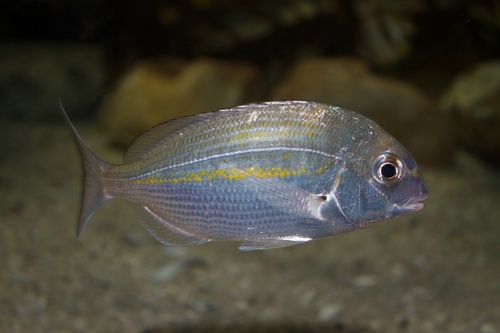
Cape Stumpnose
Rhabdosargus holubi
The Cape Stumpnose is a shimmering silver resident of South Africa's coastal waters, famous for the bold golden stripe that marks its side. A vital link in the estuarine food web, this social fish is a delight for underwater observers and coastal explorers alike.
Quick Identification
Size
Maximum length of 40 cm (15.7 in) and weight up to 1.5 kg (3.3 lbs), though typically found around 15–25 cm in estuaries.
Colors
Silvery-white body with a prominent, horizontal golden-yellow band running from the gill cover to the tail; fins are generally clear to yellowish.
Key Features
- Distinct bright golden-yellow stripe along the mid-flank
- Compressed, oval-shaped silver body
- Blunt, rounded snout with a small mouth
- Single dorsal fin with 11 spines and 12-13 soft rays
When You’ll See Them
Geographic range
Where Does the Cape Stumpnose Live?
The Cape Stumpnose is a signature species of the South African coastline, primarily found along the southern and eastern shores of the country. Its range begins around the Berg River on the Atlantic coast, extending around the Cape of Good Hope and eastward through the Eastern Cape and KwaZulu-Natal, occasionally reaching as far north as southern Mozambique. This fish is most abundant in the warm-temperate estuaries that serve as its primary nursery grounds.
Basemap © OpenStreetMap contributors
Behavior
The Cape Stumpnose is a highly social and adaptable species, particularly well-known for its estuary-dependent lifecycle. Juveniles enter estuaries at a very small size and remain there for several years, utilizing the sheltered, nutrient-rich waters as a nursery. Within these environments, they form loose schools and are often observed 'grazing' on the surfaces of seagrasses or picking through sandy substrates for food.
As they mature, these fish migrate out to the open ocean to spawn over rocky reefs, though they rarely stray far from the coastline. They are generally cautious fish but can become accustomed to human presence near docks and jetties. In an aquarium or observed via underwater camera, they exhibit a curious but skittish nature, quickly darting into cover if they perceive a threat from above, such as a predatory bird.
EverydayEarth exclusive
Camera Tips
Capturing the Cape Stumpnose requires an underwater setup, such as a waterproof action camera or a dedicated underwater trail camera. For the best results, focus your efforts on the 'push' of the incoming tide in a coastal estuary. As the clear, salty ocean water moves in, visibility improves dramatically, allowing for much crisper footage of the fish's silver scales and golden stripe. Position your camera near a patch of eelgrass (Zostera), as this is their primary foraging ground.
To keep the camera stable against tidal currents, mount it to a weighted baseplate or a low-profile sand stake. Angle the lens slightly upward toward the surface; this utilizes the natural light filtering through the water to highlight the fish's iridescent colors. If you are placing the camera near a private dock or canal wall, ensure the lens is at least 30-50 cm away from the structure to allow the fish enough room to school in front of the frame.
Using a bait lure is highly effective for this species. A small mesh 'chum' bag filled with crushed mussels, prawns, or even canned sardines will quickly draw a school to your lens. For the most natural behavior, place the bait slightly to the side of the frame so the fish are captured swimming across the field of view rather than crowding directly against the lens. Early morning or mid-afternoon provides the best lighting, as the sun's angle reduces harsh reflections off the water's surface.
Similar Species
Species that look similar or are commonly confused with Cape Stumpnose.
Frequently Asked Questions
Record Cape Stumpnose at your habitat
Connect a camera to start building your own species record — AI identifies every visitor automatically.