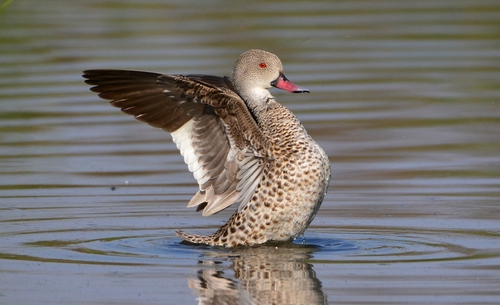
Cape Teal
Anas capensis
With its striking pink bill and pale, mottled plumage, the Cape Teal is one of Africa's most distinctive and adaptable dabbling ducks. Often found in salt-crusted lagoons and sun-drenched wetlands, this hardy bird is a master of the sub-Saharan waterways.
Quick Identification
Size
Length: 44–46 cm (17–18 in); Weight: 315–500 g (11–18 oz)
Colors
Pale mottled grey and brown body; bright pink bill with a black base; metallic green and black wing speculum bordered by broad white bands.
Key Features
- Bright pink bill with black base
- Large white wing patches visible in flight
- Uniformly pale, mottled plumage
- Red or orange-red eyes in adults
When You’ll See Them
Geographic range
Where Does the Cape Teal Live?
Native to the African continent, the Cape Teal is most commonly found throughout Southern Africa, with high population densities in South Africa, Namibia, and Botswana. Beyond this southern stronghold, it occupies a fragmented range that extends through the Rift Valley of East Africa and into parts of Ethiopia and Sudan. There are also isolated populations near the Chad basin, reflecting its ability to thrive in diverse wetland environments across the sub-Saharan region.
Basemap © OpenStreetMap contributors
Behavior
The Cape Teal is a versatile and highly active dabbling duck, often observed in small groups or pairs rather than massive flocks. Unlike many other duck species that require strictly freshwater, these birds are remarkably tolerant of saline and brackish environments. They are frequently seen in salt pans and lagoons, where they exhibit a curious and relatively bold nature, often allowing observers to get closer than other more skittish waterfowl.
Their foraging behavior is classic for a dabbling duck, involving head-dipping and 'up-ending' to reach aquatic nutrients. However, they are also surprisingly capable divers when searching for food or avoiding predators. During the breeding season, they become quite vocal, with males producing a distinctive whistling call during elaborate courtship displays that involve rhythmic head-shaking and splashing.
EverydayEarth exclusive
Camera Tips
To successfully capture Cape Teal on camera, focus your efforts on the water's edge. These ducks are shallow-water specialists, so positioning your camera on a low-profile mount just 6 to 12 inches above the mudline is ideal. This low angle provides an intimate perspective that highlights their unique pink bill and eye color while avoiding the flat look of shots taken from a high bank.
Since they are nomadic and highly dependent on water availability, maintaining a consistent water level in a backyard pond or wetland patch is the best way to keep them returning. They aren't traditional bird-feeder visitors, but they are attracted to areas with healthy submerged vegetation and muddy banks rich in invertebrates. If your camera has a 'Time-Lapse' mode, consider using it during the early morning hours to monitor large sections of shoreline where they might congregate to preen.
Trigger speed is crucial for waterfowl; set your camera to its most sensitive setting and use a burst mode of 3-5 photos. Cape Teal are active movers, frequently splashing and stretching their wings. For the best lighting, aim your camera north or south to avoid the direct glare of the African sun reflecting off the water, which can wash out the bird's pale plumage and make identification difficult.
Similar Species
Species that look similar or are commonly confused with Cape Teal.
Frequently Asked Questions
Record Cape Teal at your habitat
Connect a camera to start building your own species record — AI identifies every visitor automatically.