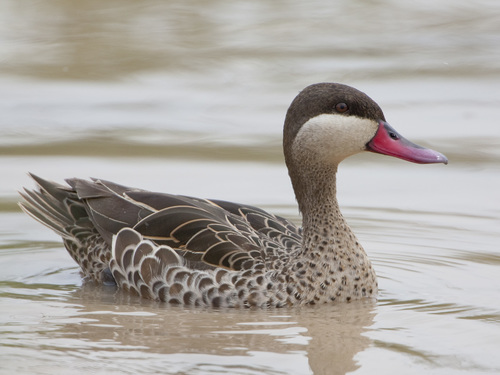
Red-billed Teal
Anas erythrorhyncha
Recognized by its striking crimson bill and bold, dark cap, the Red-billed Teal is the most abundant duck in southern Africa. A master of the nomadic lifestyle, this elegant dabbler travels vast distances to find the perfect wetland home.
Quick Identification
Size
Length: 43–48 cm (17–19 in); Wingspan: 65–75 cm (25–30 in); Weight: 300–800 g (0.6–1.8 lbs)
Colors
Distinctive pinkish-red bill; dark brown cap contrasting with creamy-white cheeks and throat; body feathers are dark brown with pale buff edges giving a scalloped appearance.
Key Features
- Bright red to pinkish bill
- Dark brown cap contrasting with pale cheeks
- Mottled brown plumage with pale feather edges
- Buff-colored wing patch (speculum) visible in flight
When You’ll See Them
Sightings on EverydayEarth
Jul 10, 2026
A group of White-faced Whistling-Ducks is gathered on the muddy bank in the foreground, engaged in preening and resting. In the water behind them, several Red-billed Teals are swimming, and one takes flight near the end of the clip. A Grey Heron stands perfectly still in the background brush near the water's edge, likely hunting.
Geographic range
Where Does the Red-billed Teal Live?
The Red-billed Teal is a widespread resident of the African continent, with its primary strongholds located throughout Southern and Eastern Africa. Its native range extends from Ethiopia and Sudan in the north, moving southward through the Great Lakes region of Kenya and Tanzania, and reaching its highest population densities in South Africa, Namibia, and Botswana. While they are a staple of the sub-Saharan interior, their nomadic nature means they can appear almost anywhere seasonal rains create temporary water bodies, though they are generally absent from the heavily forested regions of Central Africa.
Basemap © OpenStreetMap contributors
Behavior
Red-billed Teals are highly social and gregarious birds, often gathering in massive flocks that can number in the thousands outside of the breeding season. As dabbling ducks, they are frequently observed upending themselves in shallow water to reach submerged vegetation, though they are also capable of diving when necessary. They are known for being quite vocal in flight, with males producing a soft, wheezing whistle and females a characteristic descending quack.
Unlike many northern hemisphere ducks, the Red-billed Teal is not a seasonal migrant but is instead a highly nomadic species. They possess an incredible ability to track rainfall across the African continent, flying hundreds of kilometers overnight to find newly flooded pans or drying wetlands. In suburban environments, they are relatively tolerant of human activity and are common sights on garden ponds and golf course water features, provided there is enough cover to feel secure.
EverydayEarth exclusive
Camera Tips
To capture high-quality footage of Red-billed Teals, camera placement is everything. Position your AI-powered camera at the water's edge, roughly 15-30 centimeters (6-12 inches) above the ground. If you are using a stake or a low tripod, angle the lens slightly downward toward the muddy shoreline where they often forage. Because these ducks are highly active during the crepuscular hours and even at night, ensure your camera's infrared or 'No-Glow' LEDs are clean to capture clear black-and-white behavior without spooking the birds with a visible flash.
While they are natural foragers, you can encourage Red-billed Teals to pose for the camera by placing a small amount of floating waterfowl feed or cracked corn in the shallow water directly in front of the lens. Try to place the bait in water that is only a few inches deep; this encourages 'dabbling' behavior and keeps their heads above or near the surface for better facial recognition and clearer shots of that iconic red bill. Avoid placing the camera in thick reeds, as wind-blown vegetation can lead to hundreds of false triggers.
For the best color and detail, set your camera to take short video clips (15-20 seconds) rather than just still photos. This allows you to capture their social interactions and preening behaviors. During the dry season, prioritize locations near permanent water holes or farm dams, as the ducks will be much more concentrated and predictable in these areas. If your camera allows for sensitivity adjustments, set it to 'High' to ensure the movement of a swimming duck triggers the sensor quickly enough to catch the action before they swim out of frame.
Similar Species
Species that look similar or are commonly confused with Red-billed Teal.
Frequently Asked Questions
Record Red-billed Teal at your habitat
Connect a camera to start building your own species record — AI identifies every visitor automatically.