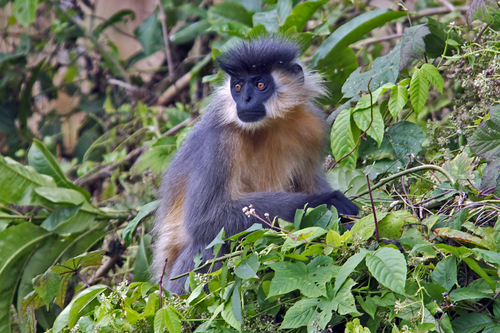
Capped Lutung
Trachypithecus pileatus
Featuring a striking black crown and a golden-orange belly, the Capped Lutung is the stylish acrobat of the Himalayan foothills. This shy, leaf-eating primate lives life in the high canopy, moving with silent grace through the forests of South Asia.
Quick Identification
Size
Head-to-body length 50–70 cm (20–28 in); tail length 70–100 cm (28–39 in); weight 10–14 kg (22–31 lbs)
Colors
Dark charcoal-grey to slate back; pale cream, golden, or orange underparts; black facial skin; distinctive black crown of hair.
Key Features
- Erect black 'cap' of hair on the crown
- Long tail significantly exceeding body length
- Bright orange or golden-yellow ventral side contrasting with dark back
- Absence of white eye-rings common in other langurs
When You’ll See Them
Geographic range
Where Does the Capped Lutung Live?
The Capped Lutung is a jewel of the Asian tropics, native to the lush, hilly regions of the eastern Indian subcontinent and Southeast Asia. Its range is centered in the subtropical forests of northeastern India, including the states of Assam and Meghalaya, and extends through the kingdom of Bhutan and the northern forests of Bangladesh. These primates are also found in the northwestern regions of Myanmar, where they thrive in the foothills of the Himalayas and surrounding river basins. They are year-round residents of these areas, relying on stable forest ecosystems for their survival.
Basemap © OpenStreetMap contributors
Behavior
Their movement through the trees is a spectacle of agility; they use a combination of quadrupedal walking along thick branches and impressive leaps to cross gaps in the canopy. While they are wary of humans, they have been known to persist in forest fragments near villages, provided the tree cover remains dense enough to allow them to travel without descending to the ground.
EverydayEarth exclusive
Camera Tips
Focus your efforts on identifying their favorite food sources. During the dry season, cameras positioned near trees producing fresh young shoots or wild figs will yield the best results. Since lutungs move in groups, set your camera to take multiple photos or a longer video clip (20-30 seconds). Often, a scout will cross first, followed by the rest of the troop a few minutes later, providing ample time for the sensor to trigger.
Lighting can be tricky in the dense shade of the forest. Use a camera with a high-quality sensor and fast trigger speed to avoid blurred images during their high-speed leaps. If possible, angle the camera slightly downward from a higher branch to capture the striking contrast between their dark grey backs and their bright golden bellies. Midday is usually their rest period, so expect the most dynamic movement and social interactions during the cooler morning and late afternoon hours.
Similar Species
Species that look similar or are commonly confused with Capped Lutung.
Frequently Asked Questions
Record Capped Lutung at your habitat
Connect a camera to start building your own species record — AI identifies every visitor automatically.