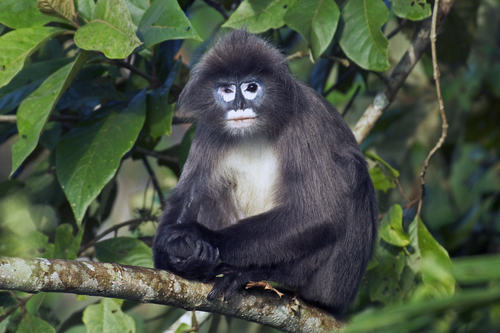
Phayre's Leaf Monkey
Trachypithecus phayrei
Recognizable by their striking white 'spectacles' and long, graceful tails, Phayre's Leaf Monkey is a master of the Asian canopy. This endangered langur lives a life of agile leaps and deep social bonds high above the forest floor.
Quick Identification
Size
Head-body 45–65 cm (18–26 in); tail 65–85 cm (26–33 in); weight 5–9 kg (11–20 lbs)
Colors
Ashy-grey to chocolate brown upper body; creamy white underparts; distinct white rings around eyes and a pale patch around the mouth
Key Features
- Prominent white 'spectacles' around eyes
- Extremely long, non-prehensile tail
- Pointed crest of dark hair on the crown
- Infants are born with bright orange fur
When You’ll See Them
Geographic range
Where Does the Phayre's Leaf Monkey Live?
This species is native to the lush, hilly regions of Southern and Southeastern Asia. Its core range spans Northeast India—particularly the states of Tripura, Mizoram, and Assam—as well as eastern Bangladesh and the majority of Myanmar. While they are occasionally found in lowland areas, they favor the rugged, forested terrain of the Indo-Burman biological hotspot.
Basemap © OpenStreetMap contributors
Behavior
Phayre's Leaf Monkeys are highly social, arboreal primates that spend the vast majority of their lives in the upper layers of the forest canopy. They live in cohesive groups typically led by a single dominant male, accompanied by several females and their dependent offspring. These groups are known for their shy and elusive nature, often retreating silently into dense foliage when they detect human presence. They communicate using a series of loud, rhythmic 'whoop' calls, which are primarily used by males to advertise territory and maintain group spacing.
Daily life for these langurs revolves around a strict routine of feeding, resting, and social grooming. Grooming serves as a vital social glue, strengthening bonds between individuals and helping to remove parasites. While they are agile leapers, capable of clearing significant gaps between trees, they are also prone to long periods of inactivity while they digest their fibrous, leaf-heavy diet in the safety of high branches. Interaction with humans is generally minimal, as they avoid open ground and fragmented habitats where they are vulnerable to predators and hunting.
EverydayEarth exclusive
Camera Tips
To successfully capture Phayre's Leaf Monkeys on camera, you must think vertically. These monkeys are almost entirely arboreal, so a camera mounted at eye level on the ground will likely only capture the occasional forest floor transit or a trip to a salt lick. For the best results, use a climbing kit or a long pole to mount your AI-powered camera 4–8 meters (13–26 feet) high on a tree trunk overlooking a 'canopy highway'—a horizontal limb that connects two major feeding trees.
Lighting in their dense forest home can be tricky, often leading to underexposed images. Position your camera to face North or South to avoid the harsh backlighting of a rising or setting sun, which can turn these dark-furred primates into featureless silhouettes. Use a high trigger speed and a short burst mode; these monkeys move with surprising speed when leaping, and a single photo may only catch a blurry tail. If your camera supports high-definition video, set it for 20-second clips to capture their complex social grooming behaviors.
Focus your efforts near seasonal food sources rather than using artificial bait, which can disrupt their natural diet. Identify trees in fruit, such as wild figs, or stands of bamboo with fresh shoots. During the dry season, cameras placed near isolated, permanent water holes or natural salt licks in the forest can be incredibly productive, as the monkeys may descend to drink or supplement their mineral intake. Always ensure your camera housing is well-camouflaged, as these intelligent primates are highly observant and may avoid a site if they spot a conspicuous new object in their territory.
Similar Species
Species that look similar or are commonly confused with Phayre's Leaf Monkey.
Frequently Asked Questions
Record Phayre's Leaf Monkey at your habitat
Connect a camera to start building your own species record — AI identifies every visitor automatically.